Romantic Road Christmas Tour / Bavaria, Germany

This Christmas we’re mounting a tour along the Romantic Road, in Bavaria Germany.

The Romantic Road links all the medieval story-book towns in Bavaria – towns like you’d see in a Disney movie. And in that month before Christmas, all these towns have their Christmas Markets open in the main square.

The Christmas Markets sell locally made handcrafts – Christmas decorations, nativity sets, and other wonderful Christmas stuff – plus there are markets that sell Christmas foods from the region.

With a bit of luck it might even snow during the tour too!

Jennifer and I traveled the Romantic Road in late November in 2013.
It was magical.
Here is a link to my Road Food blog at the time…
Bill’s Road Food blog – The Romantic Road

And here is a link on the road itself –
The Romantic Road – Germany

We already have definite commitments for this tour. It will include a night in the historic centre of Frankfurt, then seven nights staying in the glorious towns on the Romantic Road, and then two nights in a luxury boutique hotel in the Old Town of Munich.

The hotel is a 2 minute walk from the centre square and markets, and it’s just around the corner from the city’s most famous beer-hall. I’ve stayed in this hotel several times in the past and it’s in the best location possible – and it’s authentically Bavarian.

Let us know if you’re interested – and I’ll send you details of prices, dates, itinerary etc…
bill@gonetours.com

Soldier

Five-sensory & Multi-sensory humans ~

I’m reading a book at the moment called THE SEAT OF THE SOUL, by Gary Zukav.

It was recommended to me by my good friend Andrea Keir, who was the lady who helped Rhonda Byrne roll out THE SECRET’s global franchise.

THE SEAT OF THE SOUL has been around for a long time – in fact its 25th anniversary edition has just been published – and along with Zukav’s other notable book, THE DANCING WU LI MASTERS, is regarded as a classic of spiritual literature.

Zukav is a highly esteemed psychologist, a Harvard graduate, and so he’s no mug. He’s regarded as one of the founders of the New Age movement in psychology.

He comes to the spiritual domain with the eye of a scientist, the mind of an academic and the ethos of a mystic.

In his foreword to this 25th anniversary edition, he talks about how humanity is moving towards the next phase of its evolutionary journey – which he calls an “emerging force” that transitions us from being five-sensory individuals to multi-sensory individuals.

He says our five-sensory experience is starting to wind down, and our multi-sensory experience is beginning to emerge. He says the multi-sensory phase is not better than the five-sensory phase, it’s just more advanced, and offers greater opportunities for growth and development, and for us to avoid unnecessary difficulties in our lives.

Here is an excerpt:

Our current understanding of evolution results from the fact that we have evolved until now by exploring our physical reality with our five senses. This has allowed us to see the basic principles of the Universe in concrete ways. We see through our five senses that every action is a cause that has an effect, and that every effect has a cause. We see the results of our intentions. 

When the physical environment is seen only from the five-sensory point of view, physical survival appears to be the fundamental criterion of evolution, because no other kind of evolution is detectable. It is from this point of view that “survival of the fittest” appears to be synonymous with evolution, and physical dominance appears to characterise advanced evolution. 

When perception of the physical world is limited to the five-sensory modality, the basis of life in the physical arena becomes fear(my underlining… 🙂 )

Power to control the environment, and those within the environment, appears to be essential. The power to control the environment, and those within it, is the power over what can be felt, smelled, tasted, heard, or seen. This type of power is external power. 

All our institutions – social, economic and political – reflect our understanding of power being external. 

The multi-sensory individual understands that there is another kind of power, that has its roots in the deepest source of our being. This is authentic power. The evolution from the five-sensory human to the multi-sensory human is the evolution to see beyond the physical reality to the larger dynamical systems of which our physical reality is only a  part. 

The multi-sensory human is able to perceive, and to appreciate, the role that our physical reality plays in a larger picture of evolution, and the dynamics by which our physical reality is created and sustained. It is in this invisible realm that the origins of our deepest values are found. This is where our authentic power lies. 

From the perspective of the five-sensory human, we are alone in a universe that is physical. From the perspective of the multi-sensory human, we are never alone, and the Universe is alive, conscious, intelligent, and compassionate.

From the perception of the five-sensory human, the physical world is an unaccountable given in which we unaccountably find ourselves  and we strive to dominate it so that we can survive.

From the perception of the multi-sensory human, the physical world is a learning environment that is created jointly by the souls that share it, and everything that occurs within it serves their learning.

The decisions that you make and the actions that you take upon Earth are the means by which you evolve. At each moment you choose the intentions that will shape your experiences and those things upon which you will focus your attention. 

These choices affect your evolutionary process. If you choose unconsciously, you will evolve unconsciously. If you choose consciously, you will evolve consciously. 

The fearful violent emotions that have come to characterise human existence can be experienced only by personality. Only the personality can feel anger, fear, hatred, vengeance, sorrow, shame, cynicism, indifference, loneliness. 

The personality can also be loving, compassionate, and wise in its relations with others, but love, compassion and wisdom do not come from the personality. They are experiences of the soul. 

A personality that is limited to the perception of the five senses is not aware of the soul, and therefore cannot recognise the influences of the soul. As a personality becomes multi-sensory, its intuitions – its hunches and subtle feelings – become important to it.

When the personality comes to fully serve the energy of its soul, that is authentic empowerment. This is the goal of the evolutionary process in which we are involved, and the reason for our being.

I don’t know about you, but I find this absolutely fascinating.
And beautifully articulated.

I’ll post more in the coming days. There’s a whole chapter on intuition that’s fabulous. Thank you Andrea for hooking into my guidance system, and leading me to this wonderful book…

wpid-Photo-20141005074115.jpg


The debate about consciousness ~

I rarely put up YouTube videos on this site – but if you’re interested in the age-old debate between spirituality and science, as I am, then this is really worth watching.

In the left corner is Deepak Chopra, fighting for Spirituality – and in the right corner is Richard Dawkins fighting for Science.

It gets ugly…

Screenshot 2016-01-09 19.38.23

Irish Tour –

We’re starting to lock down our tours for the first part of this year –

The Camino Portuguese tour in May is now fully booked.

That’s closed.
We can’t take any more for that one.

The Irish tour still has some places available.

To refresh your memory, it’s a glorious walking / sightseeing tour of the west coast of Ireland, called The Wild Atlantic Way tour.

It’s in April, for two weeks.

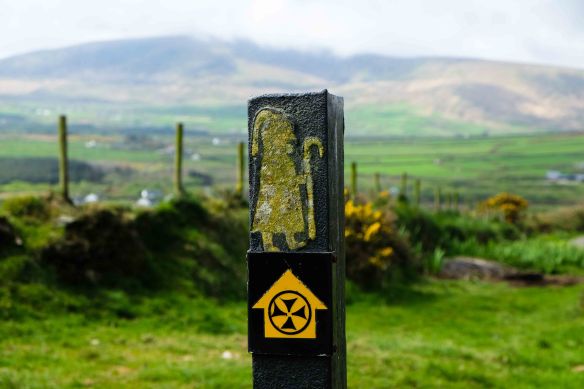
Plgrim marker.4

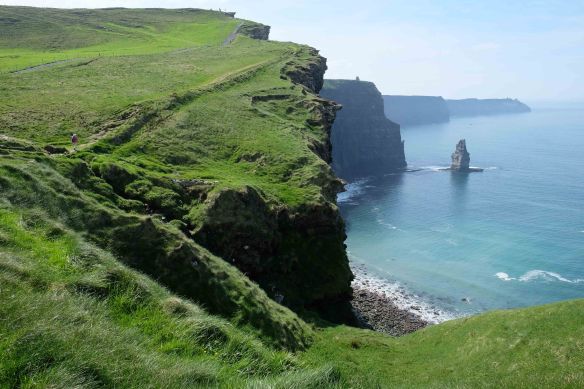
The tour will include walks around various west coast “rings,” following ancient Celtic pathways – and will also include a breathtaking walk along the Cliffs of Moher, and  a trip out to the Aran Islands.

path up cliff.2 (with Jen)

If you don’t wish to walk we’ll have transport so you can just make it a sightseeing tour.

It promises to be a truly magnificent tour.
Dates, costs, itinerary are on this link…

Wild Atlantic Way tour info – 

Please let me know if you’re interested.
We need to lock this down very soon.

bill@gonetours.com

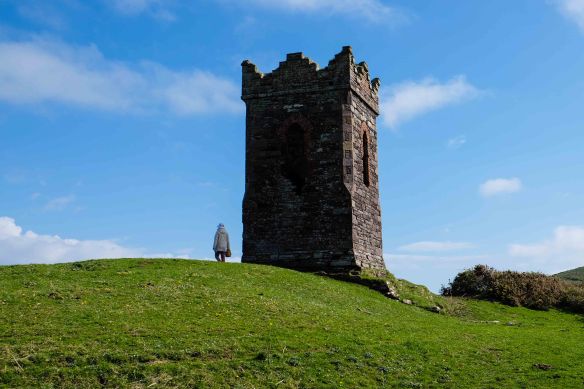
Jen by castle tower

Guest Post – Jenny Heesh / Pt3 / Blood Poisoning ~

Here is the third and last part of Jenny’s guest post on her time as a First Aid nurse on the Camino this past year. She’s left the best for last – Blood Poisoning.

Jenny – it’s been a pleasure and a privilege to host these posts here. Personally, I’ve found them fascinating, as have a lot of others who visit this blog. And I’ve also learned things too. As you know, I also had a bad Compeed experience and would never ever use it again. It nearly derailed my Camino. So thank you for posting here on PGS The Way. You are a wonderful story-teller.

Now, here is Jenny’s final instalment.
Keep your hurl buckets handy…

Blood Poisoning
Jenny Heesh

When we saw Jane at Los Arcos, she had begun walking with Kerstin, a Swedish pilgrim.  Jane had recovered well from her blisters, sore knees and the cold – she was really getting into her stride with the Camino – loving every minute of every day. 

Kerstin was also going very, very well.  When we said goodbye I told Jane that I felt we would see each other again.  She was skeptical as the legend is that, on the Camino, you only meet the same people twice, and we had seen each other twice.

However, we DID meet up with Jane again, just outside Rabe, a couple of weeks later.  By then we had moved over to the town of Castrojeriz, another spot where pilgrims often sustain injuries. 

It was one of those extraordinary Camino coincidences – we were driving out to the main road from the town of Rabe when I thought I saw Jane.  I told David, who asked me if I wanted to turn around and go back to where she was, to make sure. 

I debated whether or not we should turn back as we were heading to Burgos on another first aid mission involving the purchase of large quantities of cat food for a feline family we had “adopted” at the campsite (which is a story for another time!). 

We did turn back – it was just as well we did – Jane was with Kerstin, who was quite ill.  Kerstin was feeling dizzy and had put it down to lack of water or the heat. She then said she had a blister problem.

The moment David looked at the blister he knew she had to go to hospital. We bundled Jane and Kerstin into the car with us and set off to find a hospital, which we eventually found in a small town about 35 kilometres away.

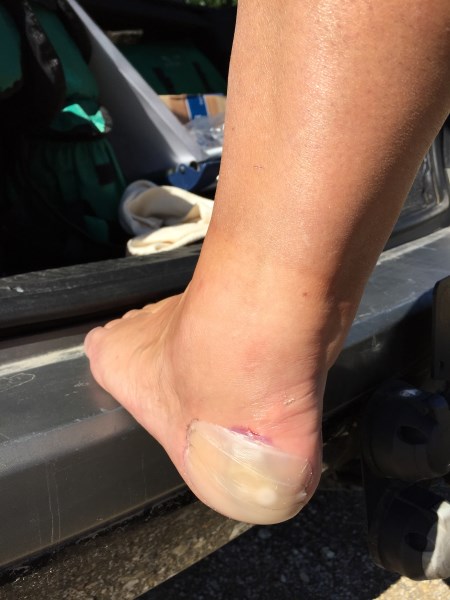
This is what had us bundle Kerstin (and Jane) into the car in search of a doctor :

Kerstin's foot before treatment

Kerstin’s problem began when she put a Compeed patch onto a heel blister. The blister had grown over the days of walking until it burst and forced an edge of the Compeed patch open. Dirt got in and it became infected.  

When we saw her she had blood poisoning – her ankle had already started to swell. The doctor in the Casualty Department of the hospital cleaned and treated the wound, gave her an antibiotic injection and horse-pill sized antibiotics and told her that her Camino was over, she had to go home.

The doctor then took David aside and said we had to keep an eye on her overnight and that if her condition deteriorated we must take her immediately to the Emergency Department in the large regional hospital in Burgos – she was really concerned for her. We did keep a close eye on Kerstin and thankfully, her condition improved overnight.

Kerstin's foot after treatment

The next afternoon we drove her to Pamplona, a distance of around 250 kms, and put her on a train to Paris, so she could make her way home to Sweden.

David and Kerstin - Railway Station, Pamplona

As we were driving Kerstin to Pamplona, we decided to pack up the caravan at Castrojeriz and return to Puente la Reina and Albergue Santiago Apostol.

We had a few nights back at the albergue carrying out first aid.  It was the third week of September – the pilgrim numbers had begun to decline and as a result the need for first aid help was not as great, so we decided it was time for our first aid mission to end. 

To finish –

Roni successfully completed her camino and is currently working on her dissertation.

Mike successfully completed his camino and is currently writing an account of his experiences as a bike pilgrim, which he intends to share with members of the Camino Forum.

Kerstin’s foot is now completely healed.  It was six weeks before she was able to walk on it normally.

For me, it was an extraordinary privilege to be able to share the first aid role with David.  Every moment, from start to finish, was wonderful.

The first aid camino was a time of caring for others, of sharing and of laughter, and of nurturing and building upon an already strong friendship.  My Camino and first aid knowledge has increased exponentially because of this experience.  I am so very grateful that David gave me the opportunity to share in the valuable work he does each year.  It was a very, very special time – thank you so very much David.

David had found on his previous first aid missions that the first aid wasn’t just about treating blisters and putting dressings on – many pilgrims were suffering internally.  I found this to be so in helping him – many apparently confident pilgrims burst into tears when we started helping them. 

Spending time talking with pilgrims, hearing their stories and providing empathy and understanding was one of the most rewarding aspects of the work.

The help, as David says, is “all about love”.  For me it WAS “all about love” – for pilgrims, for my dear friend and of course, ultimately for the Camino.

David and Jenny, photo courtesy of Cee Jacques

 photo courtesy of Cee Jacques

Good Riddance 2015?

I’ve been reading social media these past few days, as we transition from last year to this year – and I’ve been surprised at how many people have effectively said:

Good Riddance 2015

I’ve been surprised that a number of so called spiritual people have said things to this effect.

I refuse to see the past in any kind of negative way, even though some awful things might have happened.

What’s happened in the past, whether in the past year or earlier, has brought me to who I am, what I am, where I am, right now.

And I’m grateful for that.

If I hated the past, I would hate who I am right now –

And I don’t.

Because if I hate who I am right now, how can I see the future with any sense of hope, optimism, or love?

There is of course a belief amongst many that we should “live in the now,” and on one level I see merit in that. But I believe that the two dynamic forces that drive the human spirit are love and hope.

Take either away and we crumple.

To have hope, you have to look forward. It’s intrinsic to hope. And to look forward with hope you have to be at peace with the past.

You have to accept it, embrace it, honour it.

And not judge it in any kind of negative way.

Because it has made you who you are right now, stepping into the New Year…

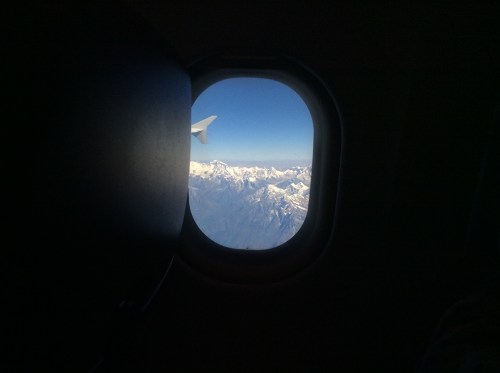
Mt. Everest

i

Guest Post – Jenny Heesh / 2nd pt / Blisters ~

Jenny Heesh yesterday posted her first part of her account of her time on the Camino administering first aid to pilgrims.

Here is the 2nd of the three part series, entitled Blisters. 

For those interested in walking the Camino, or for anyone who wants to walk long distances, there is some very handy information in this post.

PART II – BLISTERS
Jenny Heesh

The day after Mike’s departure David and I began the first aid work in earnest.

Our first stop was at Puente la Reina at Albergue Santiago Apostol.  It is a large albergue – with dormitory accommodation, smaller rooms for those wishing to minimise the sounds of the “snorechestra”, a restaurant, bar, laundry and a pool.

It also has a powered campsite for caravans and motor homes, plus an area for tents.

Albergue Santiago Apostol

We had our own albergue on wheels – a two-berth caravan with kitchen and bathroom facilities – which meant we could be self-sufficient wherever we were.

David's caravan

We stayed at Puente la Reina for several days and gradually got into a routine of providing first aid at the albergue from late afternoon and into the evening.  We met many injured pilgrims there – it was a great stop for first aid, being a few days’ walk from St Jean, the starting point of the Camino for many pilgrims, and people were beginning to experience problems.

The first night at the albergue we worked for over four hours straight, treating blisters and handing out first aid supplies.

During the evening we treated an Australian pilgrim, Jane, who had a “trifecta” of first aid problems.  She had blistered feet, sore knees and a bad cold.  David treated the blisters, gave her anti-inflammatory gel for the knees and Olbas oil for her blocked airways.

We met up with Jane again in Los Arcos two days later and she was to become instrumental in the help we gave to a Swedish pilgrim, Kerstin, a couple of weeks later.

During the day we walked into the centre of town and would chat with pilgrims as they passed through.  Often David would open the first aid pack and give out supplies such as band aids etc.  We also drove out to various villages on the Camino in the area to help anyone who needed it.

We found a lot of the problems that pilgrims had could have been prevented.  We saw dozens of pilgrims with blisters which had formed from wearing the wrong sized boots, badly fitting boots, or simply not treating a hot spot as soon as it formed.

Boots were often laced too tightly.  David rearranged the lacing on many pairs of boots – loosening the front section of the laces, with his fist stuffed inside the boot to spread it out, from the front to the third eyelets and then tying a half knot at those eyelets, and finally loosely lacing up the rest of the boot.

He showed pilgrims how to put the boots on correctly.  He told them to kick the heel right back into the boot, tie up firmly so that the rear of the boot is held firmly with the foot, and, with the half knots at those mid eyelets, the front of the boot never tightens up but stays more open, allowing the toes to move freely.

Recommended method of lacing up boots

We also found that many pilgrims would lace their boots up tight in the morning and leave them untouched until they finished walking at the end of the day, ignoring the increasing pain – some did not even know that their feet became larger during the day.

David recommended stopping at least every two hours, to take the boots and socks off and have a break, to put their feet up, then put the socks back on alternate feet (so that seam pressure points are moved) – for many this was the end of their daily discomfort or pain.

David always treated the blisters by draining them.  The blisters become larger if they’re not drained.  Firstly, he made sure the foot was clean, after which he used a disposable scalpel to make two tiny V-shaped cuts which allowed the blister to drain completely.

He would then spray antiseptic to get into all the crevices and inside the cut sections, and then covered the blister with fabric plasters.  These adhered much better than waterproof plasters and also allowed the skin to breathe.

The treatment worked really well – almost instant pain relief for most pilgrims he treated.  We also gave pilgrims a supply of plasters to keep them going until they could get to a pharmacy.

We saw many pilgrims with knee problems and shin splints.  The only sure cure for this problem is to stop walking which obviously was not an acceptable option for most pilgrims.  These problems were difficult to treat – all we could do is recommend the RICE method – rest, ice, compression and elevation.

David gave out sample-sized quantities of anti-inflammatory gel and showed pilgrims how to massage the ligaments and tendons gently but deeply to help with pain relief and recovery.  We never handed out pills of any kind – we would always recommend that the pilgrim consulted a pharmacist for oral medications.

We showed pilgrims how to walk with half-length steps, to minimize joint and muscle strain, standing as if they weren’t carrying a backpack and they felt better instantly.  We also stressed the importance of walking at their own pace – not that of their friends, and not to overdo the daily distances – and to use a hiking pole or staff for stability.

First Aid Sign in 12 languages

Guest Post – Jenny Heesh / 1st pt / Bikes ~

Jenny Heesh, most of you might know, is a regular on this blog.

She is part of the Camino Angels triumvirate, the other two being Britta Huttel and Janet Mostyn.

Let me put this as plainly and as forcefully as I can – Do not go drinking with these women. They are dangerous. Particularly around Sangria. They will have you saying and doing things you will later regret. 

Now, that being out of the way –

Jenny wasn’t able to come with Britta and Janet on the India tour because she’d locked in a biking Camino. Which in some respects I’m sort of thankful for, because with Jenny and those other two altogether, plotting their misadventures, the spiritual tour could have turned into a spiritual tour.

Anyway, her biking trip though was thwarted when she took a fall on a training ride several months beforehand. She injured herself quite severely.

But Jenny is nothing if not determined, courageous, and unstoppable when she sets her mind to something. So she segued her biking trip into something perhaps even more special, as she details below in the first part of her post.

Her post is broken up into three parts, which she has delicately entitled Bikes, Blisters, and Blood Poisoning.  Did I say she’s a cheerful thing too?

By the way, if you’ve got a weak stomach, or you have a propensity to hurl at the sight of really disgusting photographs of physical malformations, then I’d advise you to read these posts with your eyes shut…

(Happy New Year to you all by the way!!)

BIKES, BLISTERS AND BLOOD POISONING
My first aid journey on the Camino
Jenny Heesh

PART I – BIKES

Ironically, my first aid journey on the Camino last September began with an accident. 

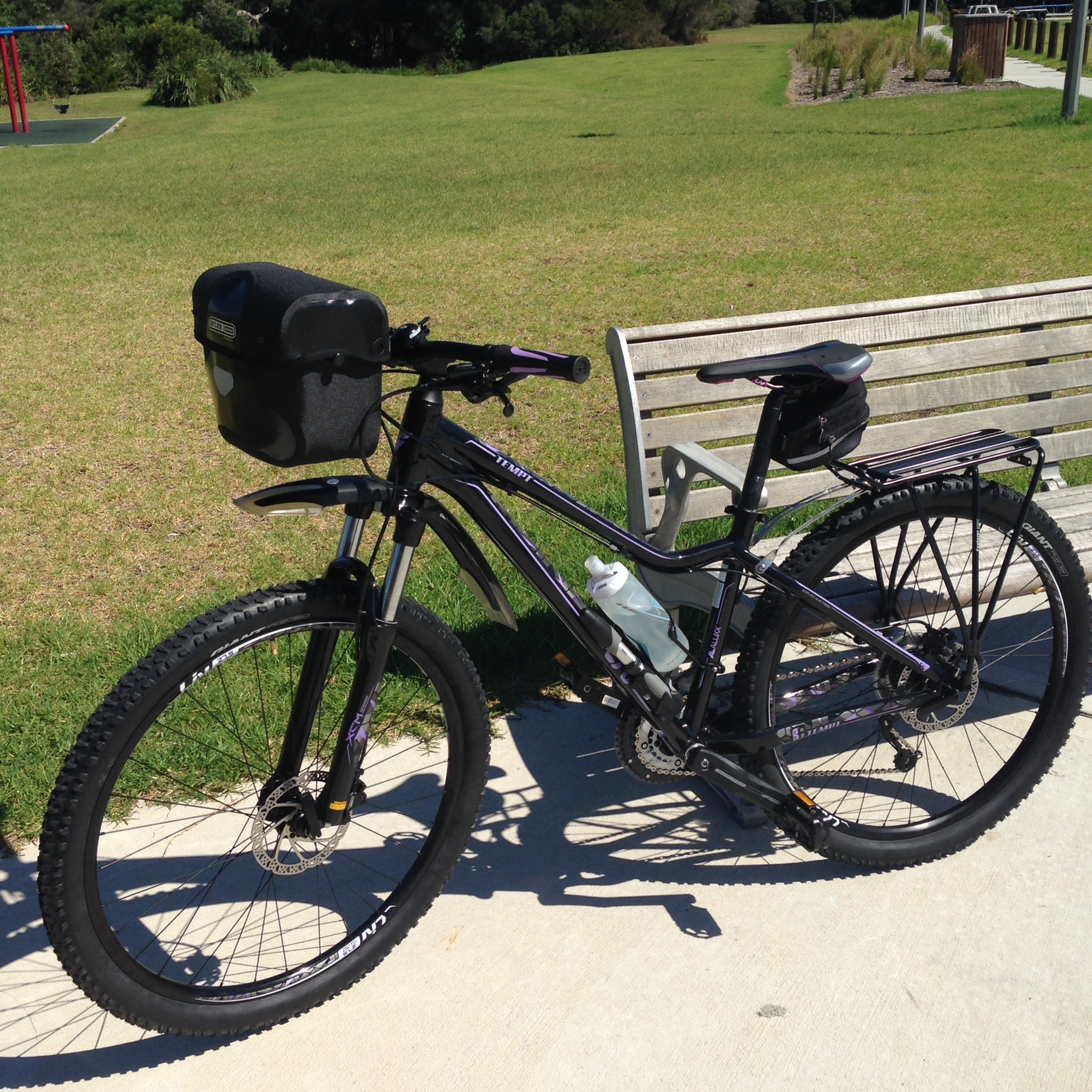
For well over a year I had planned to cycle with my friend Mike on the Camino, from Pamplona to Finisterre.  Mike and I had both invested in new mountain bikes which we planned to bring with us from Australia. 

I loved my new bike, christening it the “Camino Dreambike”.  It had more gear combinations than I would ever use on a dozen caminos, let alone ONE, plus hydraulic disk brakes and a bell that would have been music to the ears of any walking pilgrim! 

The Camino dream bike

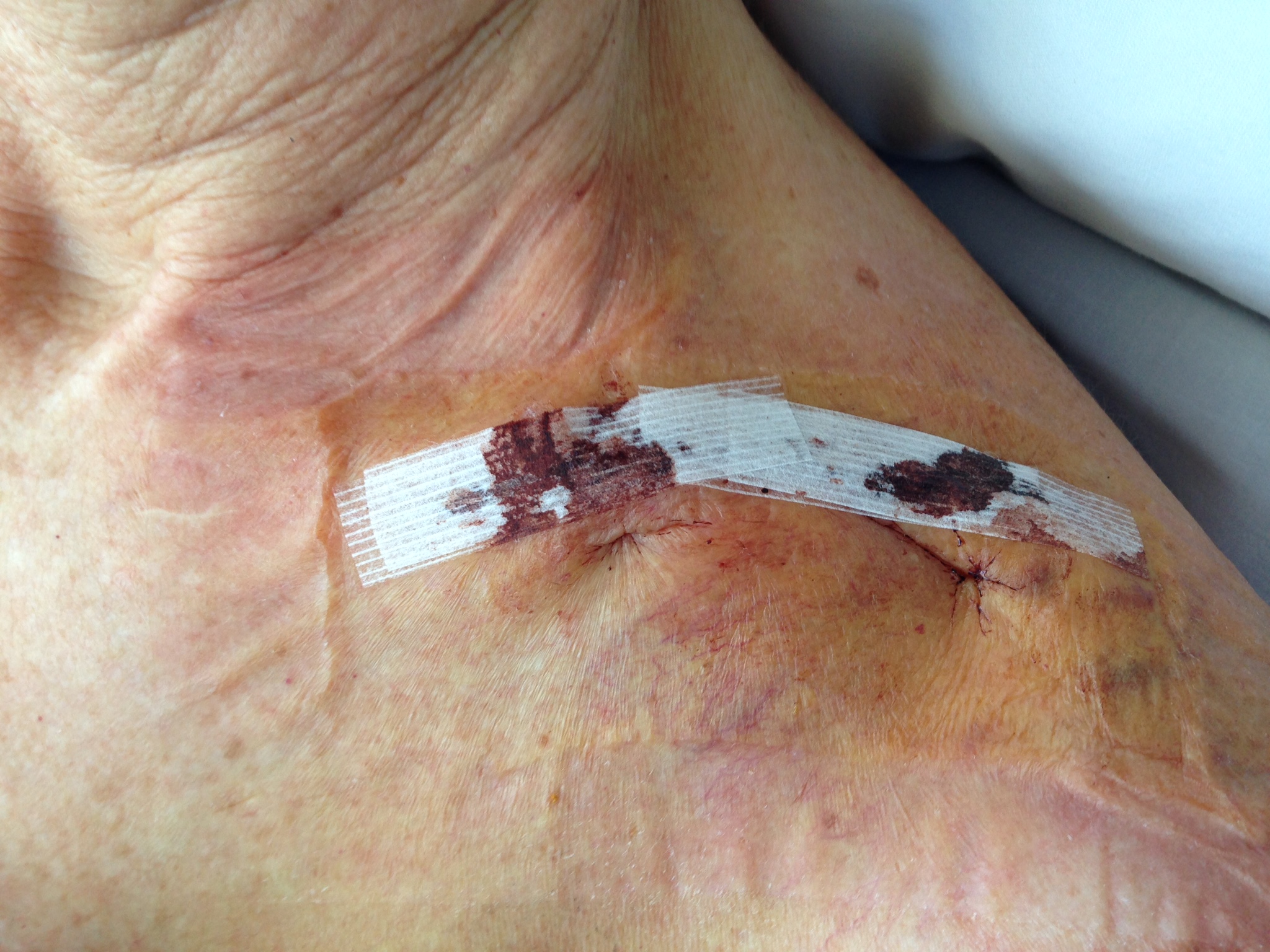
Last April, several months into training, a cycling accident ended my camino plans.  A crosswind buffeted the bike so badly that I lost control and fell, my shoulder taking the brunt of the fall.  I broke my collarbone and scapula and in May, when no bone knitting was evident, I had surgery to pin and plate the collarbone. 

The pinned and plated collarbone

The injury, though not major, was nonetheless painful, both physically and emotionally.

An unexpected offer in June turned the way I was dealing with the injury around completely.  My friend David from the UK, knowing that the bike camino could not happen, offered me the opportunity to help him carry out first aid on the Camino. 

I accepted his kind and generous offer straight away and quickly whipped into planning mode for the new and very different camino.

David is a veteran first-aider who has provided first aid, pastoral care and support to pilgrims on the Camino, generally twice a year since 2006 – all on a voluntary basis.  His first aid caminos are funded partly through the profits from his online Camino shop – http://stores.ebay.com.au/pilgrimsupplies.  He uses his own savings to fund the balance of the cost.

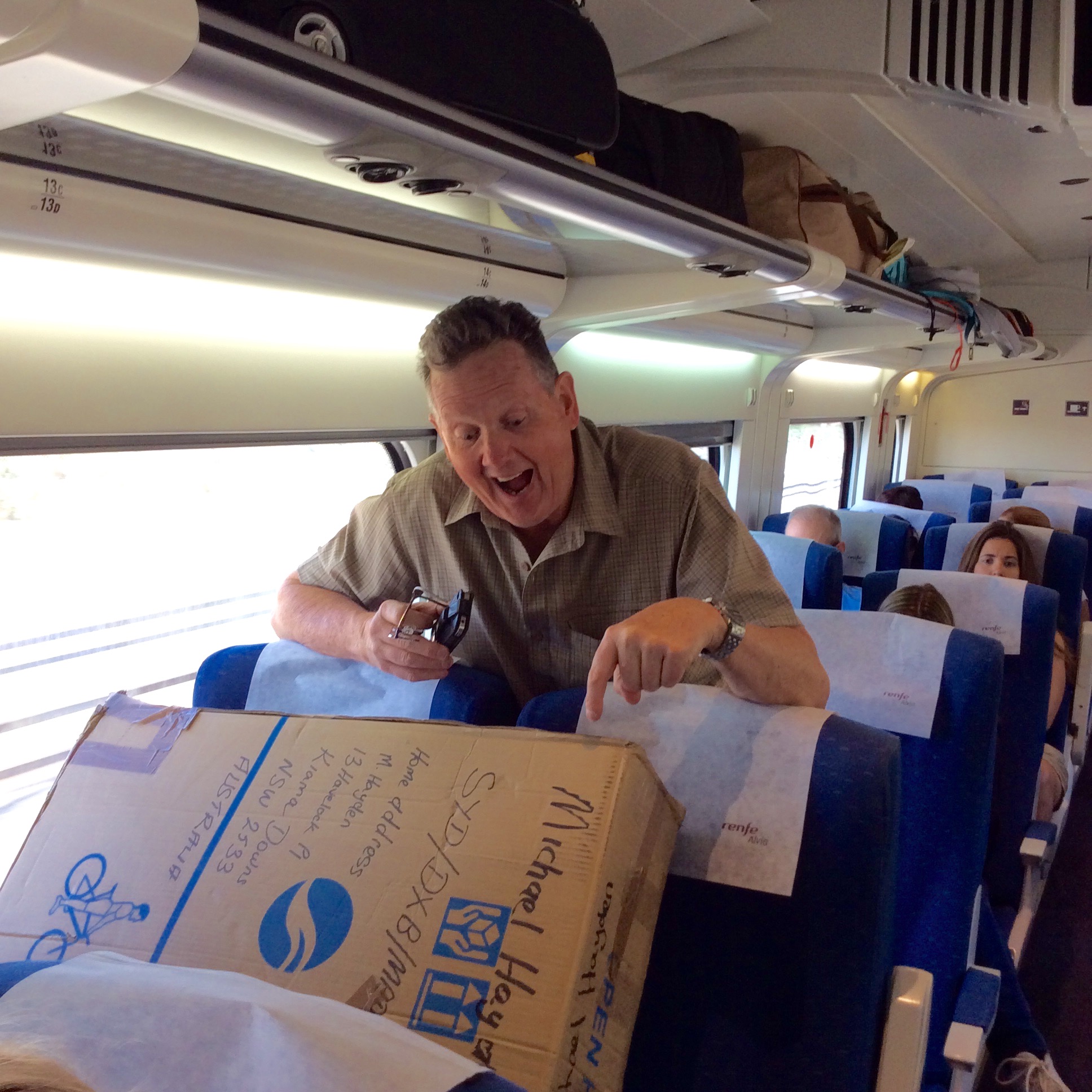
I flew to Spain on 1 September, joining up with Mike in Madrid before we both travelled by train to Pamplona where David was waiting for us.  There were two spare seats in front of us so we commandeered them for Mike’s bike, which received some rather strange looks from the train conductor and other passengers in our carriage! 

Mike with the boxed up bike

On the train we met Roni from Oklahoma, who was to be the first pilgrim we helped.  Roni was a graduate student who was doing her Ph.D. dissertation on the way that technology affects pilgrimages on the camino.  As well as making her own pilgrimage, she planned to conduct interviews all along The Way for her dissertation. 

She had arrived in Madrid from the USA early that morning and wasn’t looking to a three-hour wait for the bus to Roncesvalles, her starting point.  Arriving so late in Roncesvalles meant that the chance of a bunk at the main albergue – Refugio de Peregrinos de Roncesvalles – was not good. 

We introduced Roni to David and as soon as he heard about Roni’s wait for the bus he offered to give her a lift to Roncesvalles in his car.  After dropping our gear off at our hotel we all headed straight to Roncesvalles, with Roni managing to secure her place at the historic albergue. 

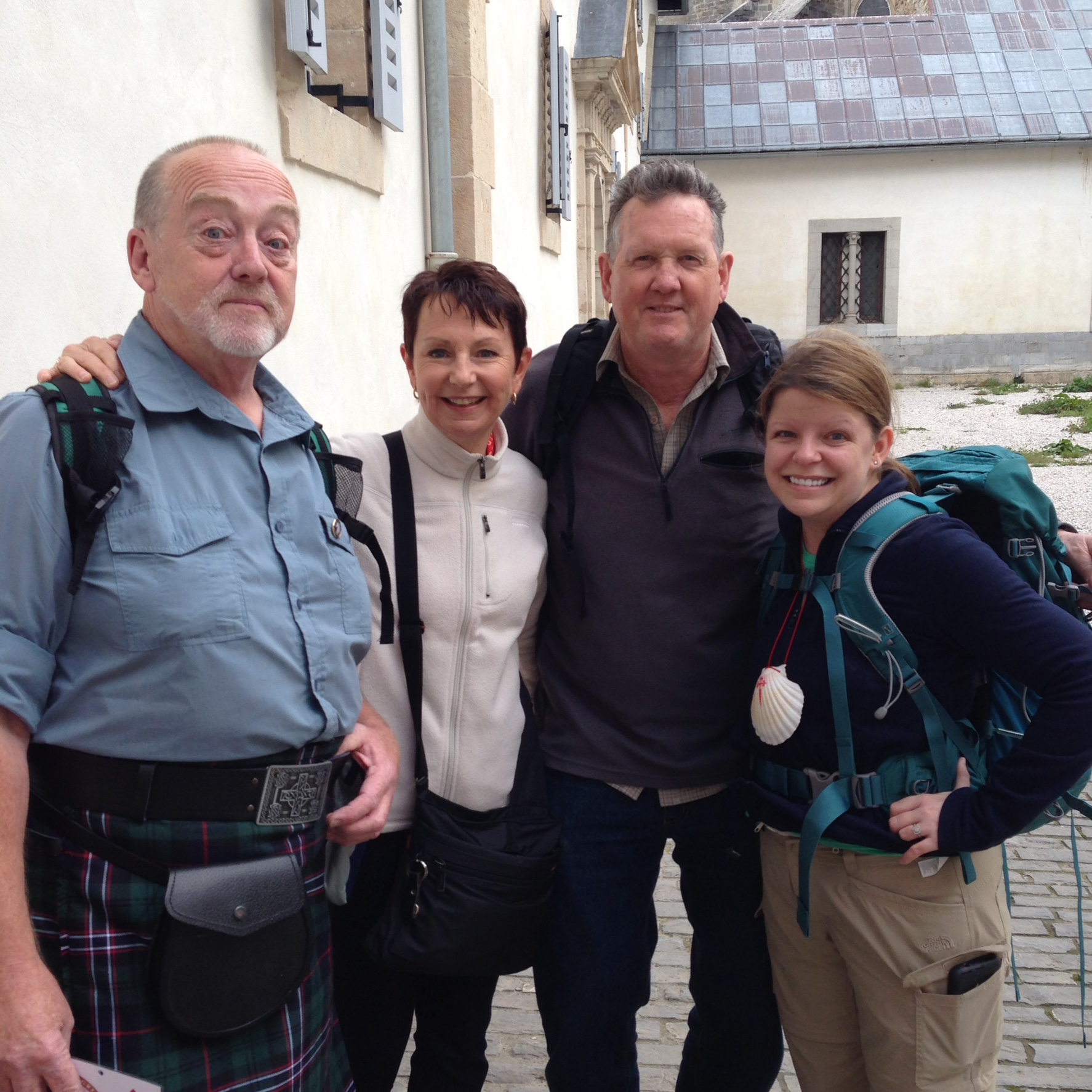
David, Jenny, Mike and Roni at Roncesvalles

Meeting Roni, and getting to know her a little, was an absolute delight and it was a wonderful start to my camino. 

While at Roncesvalles David and I began work as a first aid team and I experienced my first taste of the work that would be our focus for the weeks to come.

At the albergue David made an announcement in several languages that we were offering first aid at no charge for anyone who needed help.  There were several pilgrims who did, so we spent around an hour carrying out first aid before we said farewell and “Buen Camino” to Roni.

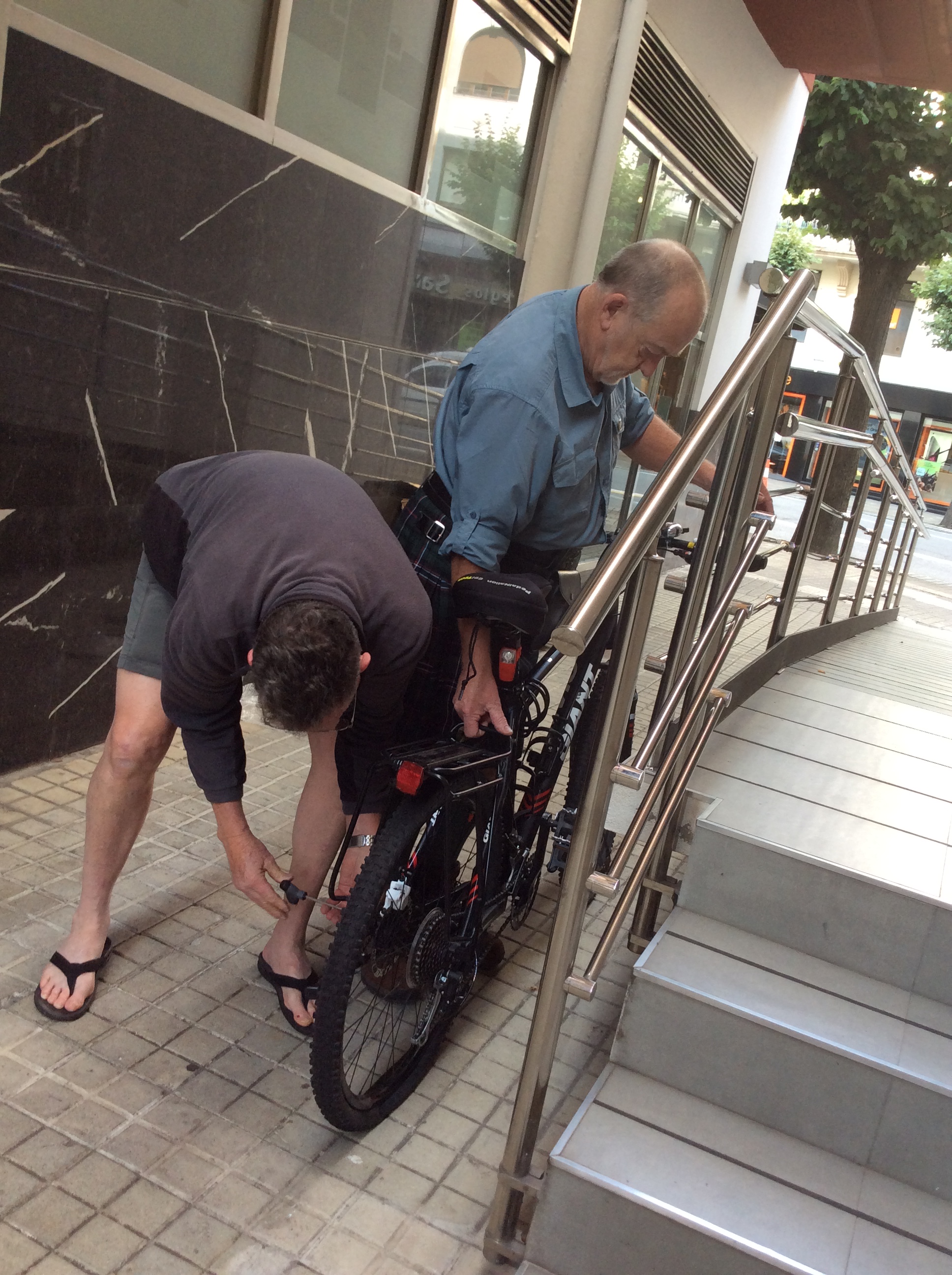
The next day Mike and David reassembled Mike’s bike in readiness for his departure the following morning. 

Mike and David reassembling the bike

Mike about to leave - cold feet perhaps

David and I waved goodbye to Mike – our shouts of “Buen Camino” bouncing off Mike’s helmet as he cycled away on a sunny Pamplona morning.  I had mixed emotions seeing him leave – disappointment at the thought that I was unable to join him on our planned camino – but at the same time I was very excited and happy to be undertaking a completely different camino – a first aid camino.

Mike pedaling away

Part two coming tomorrow…

My favourite photos of 2015 ~

Around about this time of the year, I post my favourite photos of the year.

Notice I don’t say best – because there’s no such thing as a best photo, just like there’s no such thing as a best film.

It’s all subjective.
It’s all in the eye of the beholder.

2015 was a big year of traveling for me – what with all the filming on my PGS Intuition film. And when I’m filming I find it hard to take photos not related to the filming.

My head is elsewhere.
So is my eye.

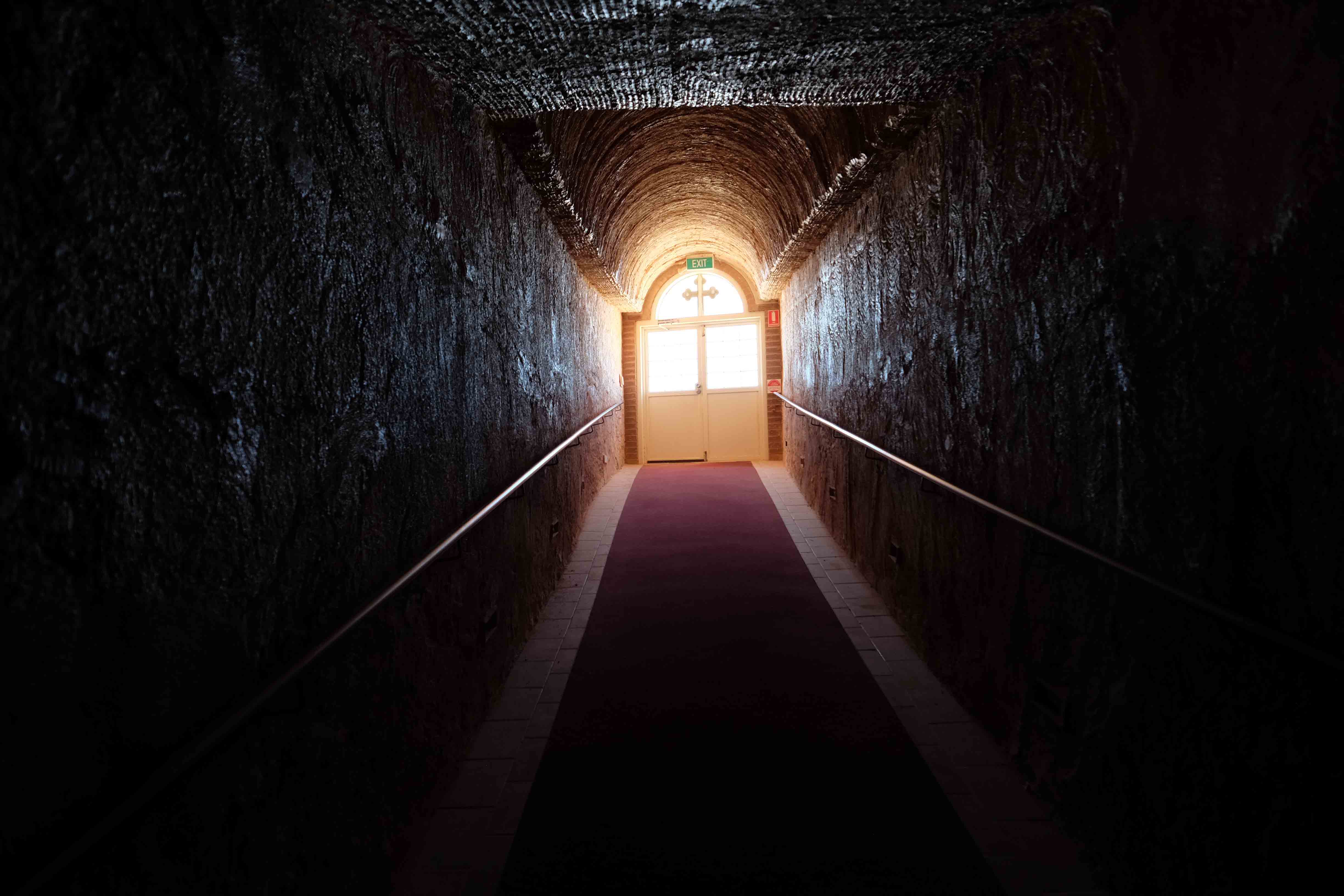
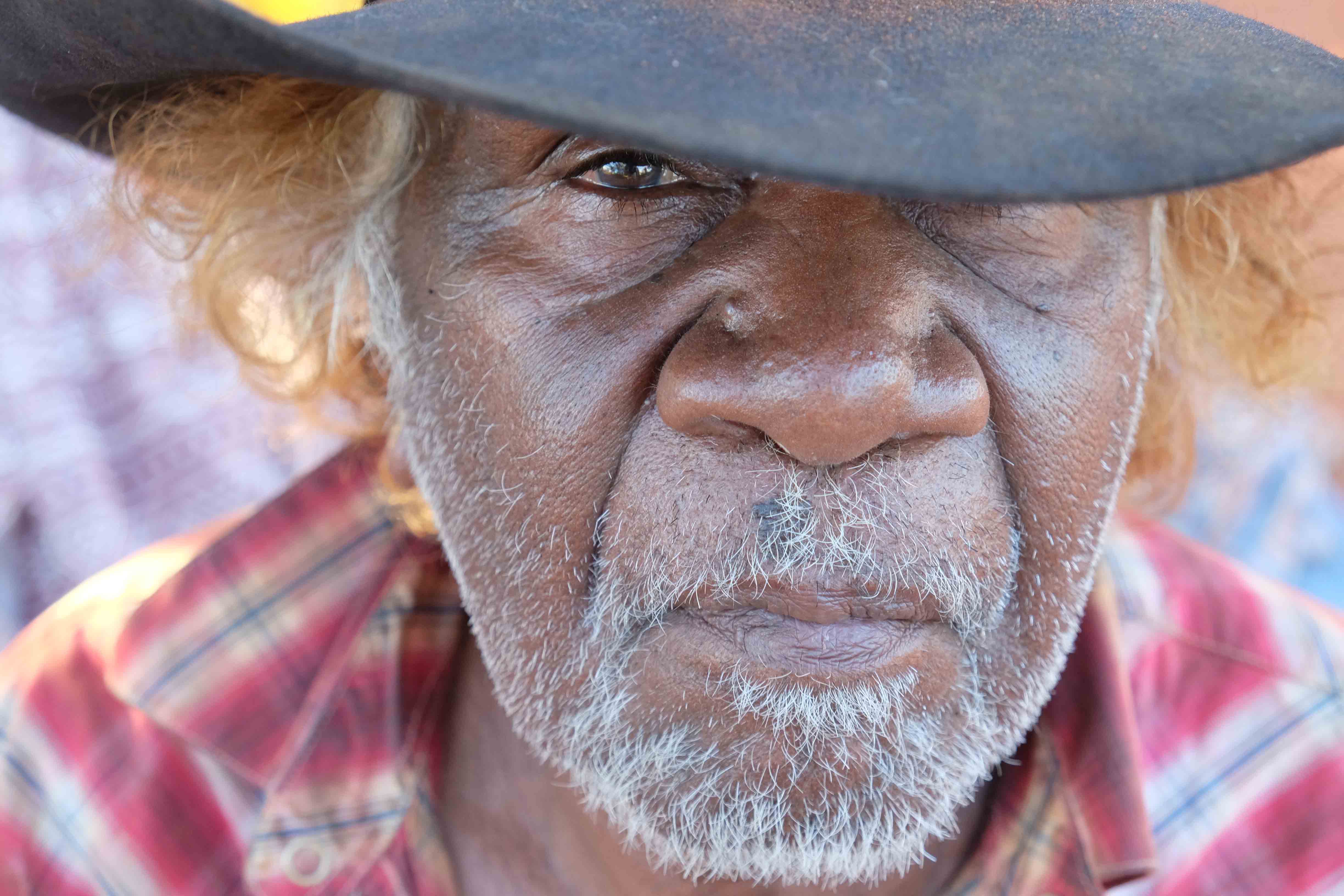
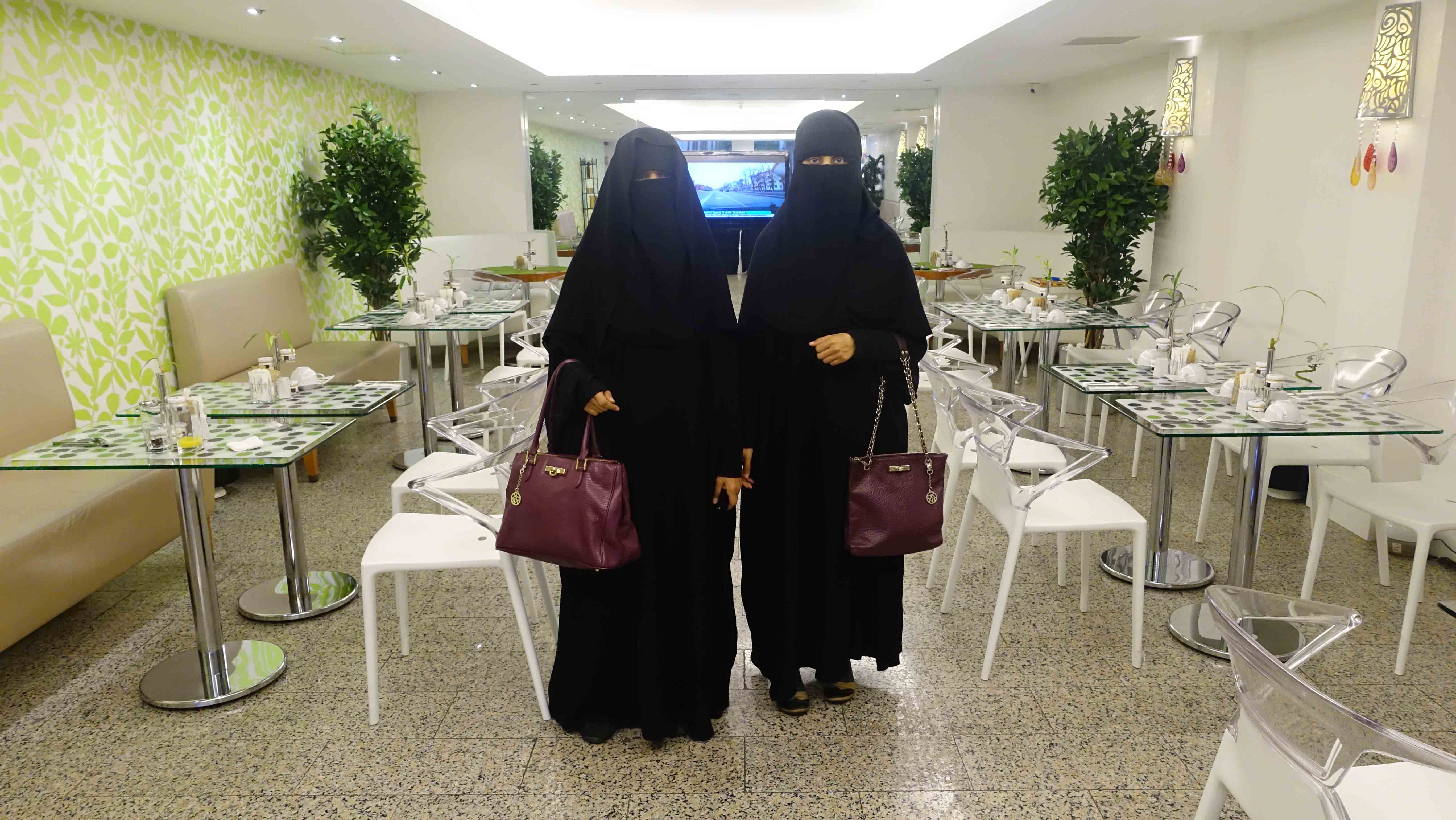
Anyway, here are the shots that stirred my soul. They may not stir yours; in fact, you might think I’m nuts selecting some of the shots that I have – but these ones I quite like…Serbian church int

Cowboy CU

Jen heading to Basilica2 Ladies in breakfast room Models 3 Man with dog

Burnt toast

missing girls runners AC chair car cpyright BIll Bennett © Bill Bennett

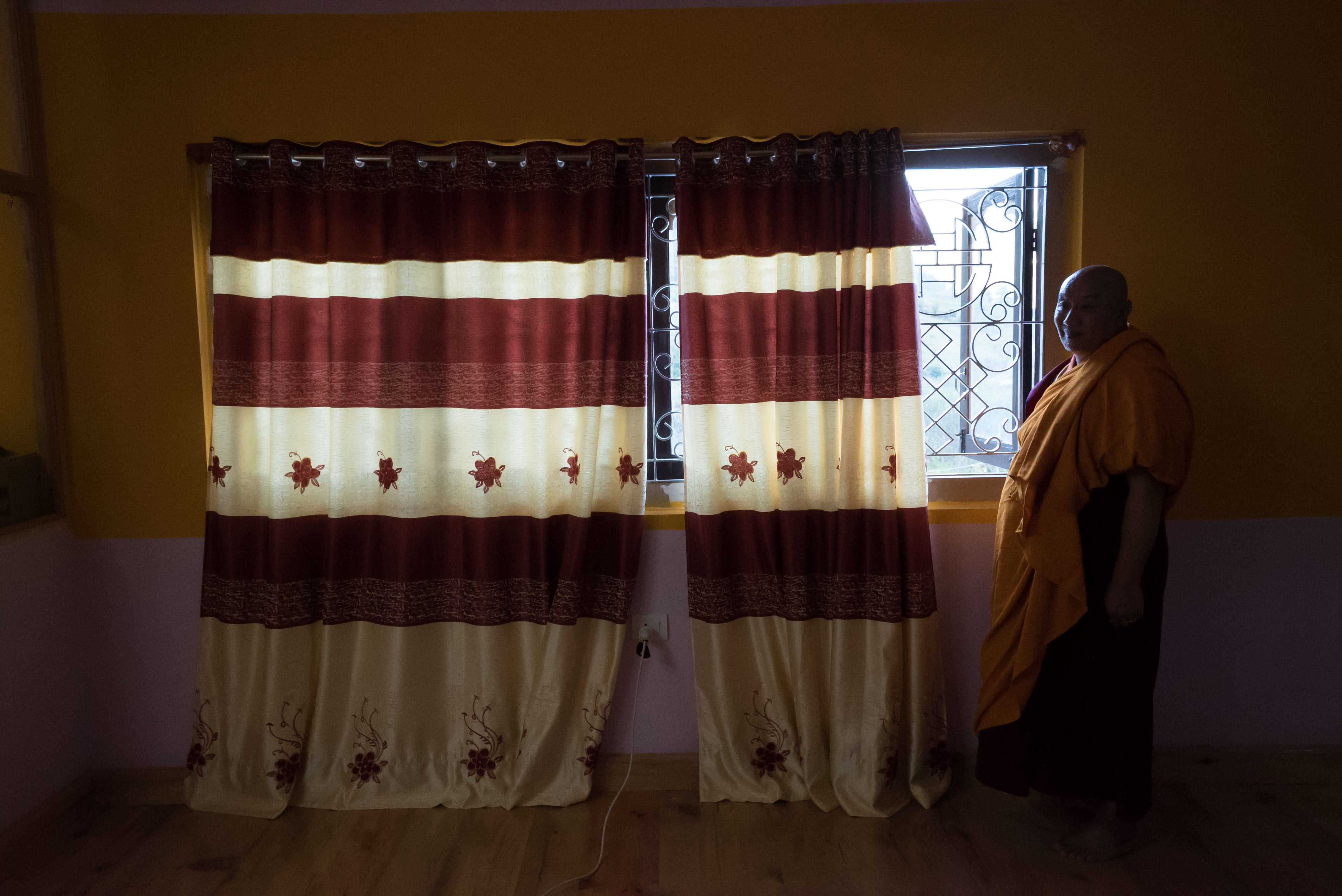
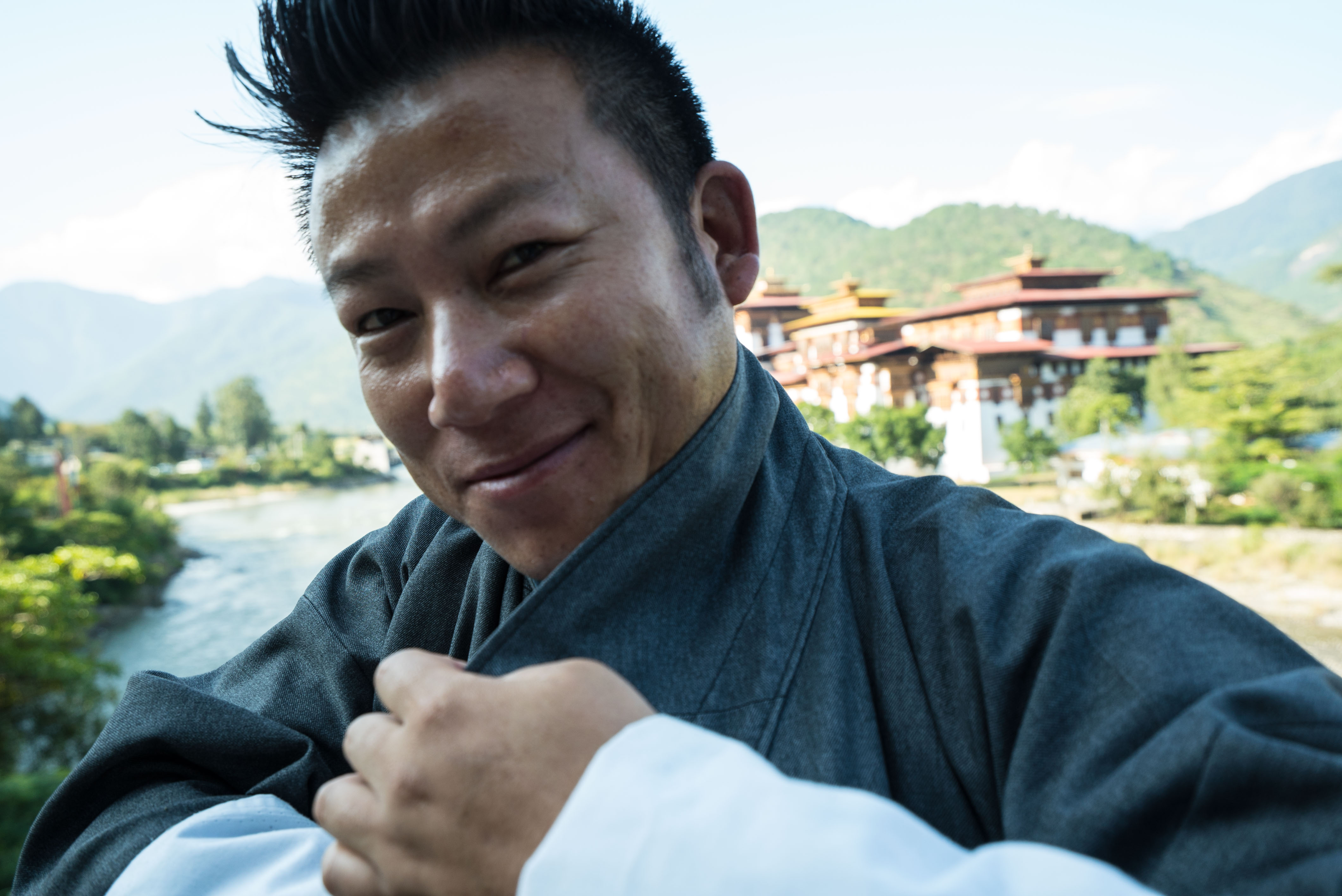
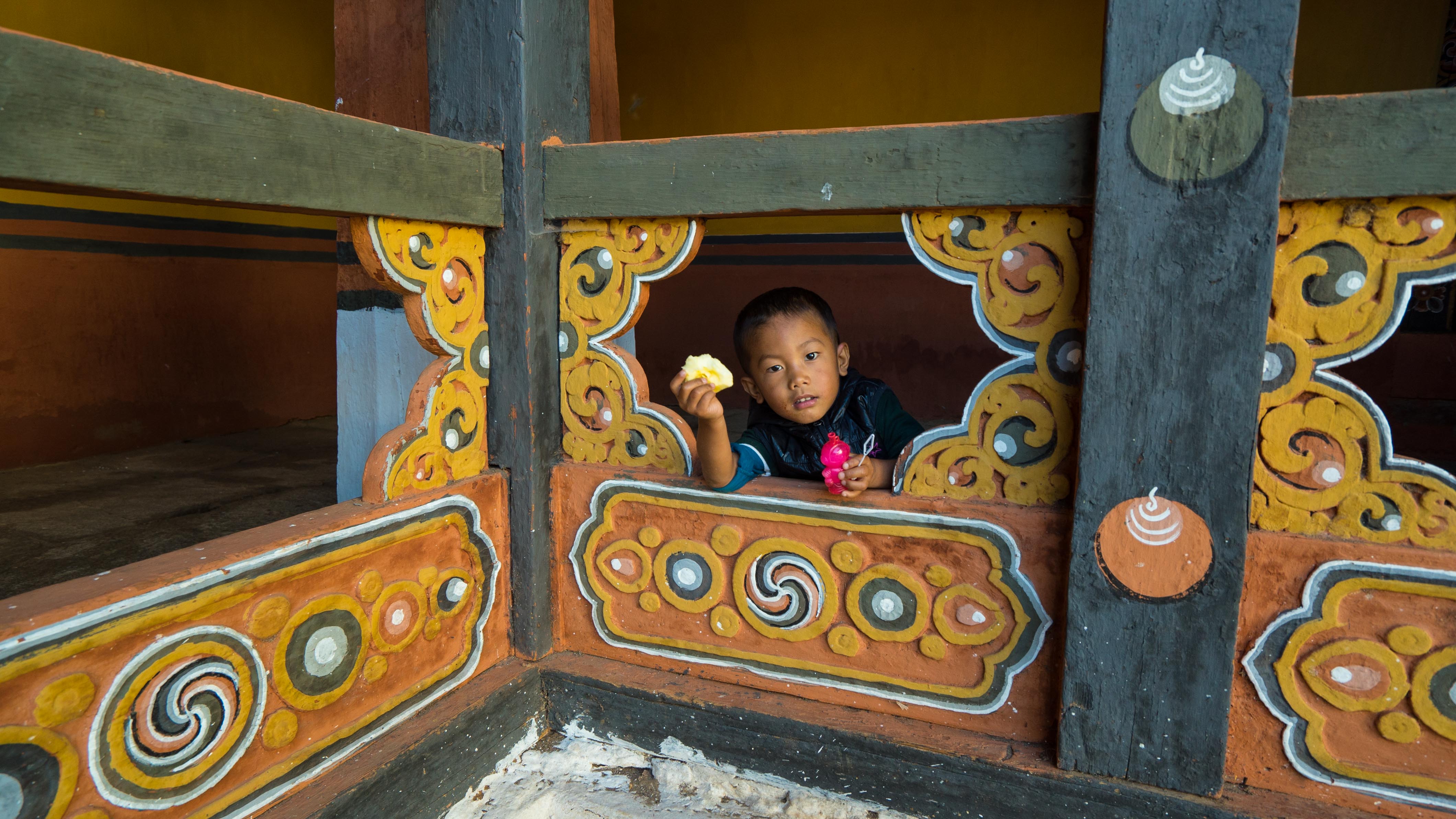
Lotus blossoms in market Dharamsala Market worker, Thimphu Bhutan Buddhist Master, Bhutan © Bill Bennett © Bill Bennett

Screenshot 2015-12-30 09.03.04 car in istanbul-1 eggs-1