My traveling camera kit ~

Here are the cameras and lenses I’ll be taking on the road trip –

SONY system:
Sony a7s – full frame
Sony 70-200mm f4
Zeiss 16-35mm f4
Zeiss 24-70mm f4
Leica 18mm f3.8

NIKON system:
D700 – full frame
Nikkor 16-35mm f4
Nikkor 24mm  f1.4
Nikkor 50mm f1.4
Nikkor 85mm f1.8

FUJIFILM system:
Fujifilm X-E-2 – APS-C sensor
Fujinon 18-55mm f2.8-f4 (27-87mm equiv)
Fujinon 14mm f2.8 (21mm equiv)
Fujinon 60mm macro f2.4 (90mm equiv)
Fujinon 35mm f1.4 (50mm equiv)

Why all the cameras?

Well, the Sony system is largely for video work, but I’ll also be using it as a stills camera for the wedding – particularly with the spectacular 70-200mm lens.

The Nikon system is also for the wedding – for fast focusing and also the sharp-as-a-tack 16-35mm lens. Also for desert work, because of the weather sealing, (keeps dust out) and because of the delicious 24mm f1.4. An amazing lens.

And the Fuji system is for everything else. Discreet documentary photography – an easy walk-around camera because of its size and weight.

Luckily I’m not carrying all of this on my back!

If I were walking the Camino, I’d take just one camera and two lenses – the Fujifilm X-E-2 with the 18-55mm zoom, and the Fujinon 14mm f2.4. That would cover me for just about everything, and would give good image quality.

But for this trip, I have the luxury of a car, and so I can take the whole she-bang.

Cameras and lenses

Into the spiritual heart of Australia…

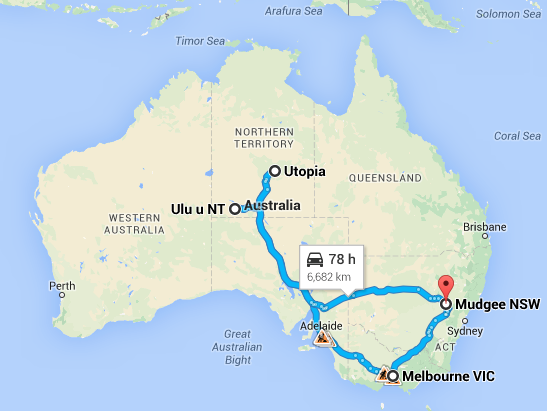
Tomorrow we leave home and head off on a three week, nearly 7000km (4300ml) road trip, which will take us into the spiritual heart of Australia.

We first drive down to Melbourne, where I’m taking some photos at a friend’s wedding. After that, we’ll catch up with The Landers Express, which is always a breathless occasion!

Peter & Julie Landers, of Portuguese Camino fame, have kindly invited us to stay overnight, so it will be a great chance to catch up – as long as they don’t break out the White Port. Last time we visited I brought them a 44 gallon drum (or thereabouts) of a Mudgee White Port.

I wonder if there’s any left?

From Melbourne we then head north, up to a remote aboriginal community north of Alice Springs. It’s called Utopia. We’ve been invited to film with some aboriginal elders – some wise men. I want to get their unique perspective on intuition for the PGS film.

Screen Shot 2015-03-11 at 8.40.52 am

We’re living with them for a few days, and they’ve also given us permission to film some ceremonial dances, which they don’t often do. So that should be fascinating.

We then drive back to Alice Springs, overnight, then the following day make our way to Uluru – once known as Ayers Rock – an iconic Australian symbol.

Uluru

I’ve traveled extensively throughout Australia, and there aren’t many places I haven’t been to during my time as a documentary maker, but I’ve never been to Uluru.

I’m looking forward to it. To me, it seems to be the spiritual heart of Australia.

Jennifer and I are staying there for five days to attend a Consciousness Retreat, convened by a very famous US spiritual channeller named Kryon. Jennifer has been listening to Kryon podcasts for years – and he has very strong and well articulated views on intuition.

We then drive back home –

We’re back about two weeks, then we’re off to Italy for the Assisi Tour, then Turkey to film with the Sufis, again for PGS. So it’s a busy time now up until mid June.

Here is a link to the Retreat –

KRYON GAIA GLOBAL CONSCIOUSNESS RETREAT 

Screen Shot 2015-03-10 at 3.03.22 pm


Photo Camino softcover price – yikes!

Wow – I’ve just been doing through the process of getting my book up on Amazon as a softcover –

I want it to be full color, because of all the photographs – and they’re saying the minimum pricing for the book will be US$38.18.

Of that, I will get a royalty of less than $8. And for their “expanded distribution – to other retailers etc – I get a royalty of 70 cents. Yes, 70 cents per book on a sale price of $38. The rest goes to Amazon for printing etc.

Crikey.

If it wasn’t full color it would be roughly the same price as my other book – about $16 or so for the softcover. The print version of The Way, My Way, is black and white.

I’m sorry about this – I want the book to be affordable- but there’s nothing I can do about it. That’s the price that amazon has set, because it’s color. And I really do think this book needs to be in color, because there’s 85 beautiful photos in it…

This is not one of them – I just like the shot. Two beautiful ladies, so happy…

Marie and Jen with umbrellas


A moment of unnecessary aggression…

I witnessed a moment on the street last week in Sydney, and it’s stayed with me.

It was nothing really.

These kind of moments happen all the time, however I found it useful – personally – to examine the moment and break it down into its component parts.

Very simply, a woman walking across a street, against the lights, was honked by a turning car. She turned around and gave him the finger – he leaned out the window as he was passing her and screamed abuse.

Moment over.

No big deal, right?

Why would I waste my time thinking about this?

Okay – the woman was pushing a pram, with a baby inside. She was also talking on her cellphone. She stepped out off the curb, thrusting her pram out front, after the green pedestrian walk sign had turned red.

It was a busy inner city intersection and this thing happens all the time.

The car turning into the street had to wait for her to cross. He had a green light, and he knew that she shouldn’t have stepped out on the red. But she had a pram. What was he going to do, run her down, and the baby too?

She felt she was in the right – probably because she had a pram and a baby, which she might have felt gave her some kind of special privilege.

The driver felt he was in the right, because this woman was walking when she shouldn’t have been walking. Not only that but she was on the cellphone, which probably riled him.

So he gave her a blast on the horn, she gave him the finger, he then screamed at her out his window, she screamed back.

In that one little interchange you have all the elements of war.

Seriously.

Both parties feeling righteous, both feeling indignant, both responding to aggression with more aggression.

Why was the driver in a hurry? He could have waited three seconds, maybe five seconds, and the woman would have walked across the street and he wouldn’t have been delayed.

Five seconds – that’s all.

He could have waited five seconds, let her pass, and gone on his way.

Equally, the woman could have waited on the curb for the next green light – a wait of what? two minutes max? She was talking on the phone, so waiting on the curb for two minutes surely would not have been a problem.

Were they both in such a hurry?

No.

She wasn’t walking fast, which probably aggravated the driver. She was casual. Distracted, talking on her cellphone.

Was he in an emergency rush?

I doubt it.

The lady bugged him. She made him angry, because she broke the rules. The rules state that as a pedestrian, you shouldn’t walk against a red warning signal. She broke the rules. And so he felt aggrieved, and felt he had the right to abuse her.

She meanwhile had given no thought to the safety of her baby in the pram. Stepping off the curb, against the red warning light, she thrust her pram out in front of her, completely oblivious to the turning car.

Had the driver not stopped, he would have hit the pram, and no doubt injured or killed the baby. What did she care? She was on the phone.

What was more important to her – the baby or the phone call?

Let’s say the driver had been on his cell too, had been distracted, hadn’t noticed the lady with the pram, and had hit them. Who would have been in the wrong? How would a jury determine damages? She was, after all, crossing the road illegally.

Let’s paint another scenario.

Supposing the driver, about to turn into the street, and seeing the woman crossing the road with her pram, waited for her. Waited patiently, and gave a moment’s thought to the kind of life she must lead, as a mother.

He would have had to wait between three to five seconds. And then he could have driven on.

But no – he turned and he blasted her with his horn and screamed abuse at her.

Supposing the woman, after the driver blasted his horn, pulled the phone from her ear, turned to the driver, shrugged and gave him a beautiful smile and said: Sorry. Instead of giving him the finger, then screaming abuse back at him.

Him being patient and forgiving, her being apologetic, is an equally plausible scenario.

But it didn’t happen that way.

We all do it. We all do what he did, and what she did.

And we all could also do the plausible scenario – be forgiving, be patient, say you’re sorry and smile.

It’s not that hard…

warship


How we do things…

I’ve got a busy period coming up.

And I have to make some big decisions.

In situations like this I check in with my PGS. And I ask Jennifer to ask her Higher Self.

This is how we make decisions.

On Thursday we drive down to Melbourne. I have to take photos at a friend’s wedding next weekend.

Then after that we drive to Adelaide to meet with some potential investors regarding the PGS film.

Now here’s where the decisions come in – because towards the end of the month we’re attending a big spiritual “convention” at Uluru – and shooting for PGS.

Plus we’ve been invited to film with some aboriginal elders up at Utopia, a very remote aboriginal community about 800kms north of Uluru. This again for the PGS film.

It’s important to get an indigenous perspective on intuition, and these elders up at Utopia are holders of ancient wisdom.

So the decision is – do we drive or fly? Driving will involve about 6000kms – some of it over rough roads.

Flying means a three hour flight, picking up a hire car, and if the car gets knocked up on the roads, then it’s not our problem.

My PGS has been telling me we should drive – I asked Jennifer today to check in with her HS, and she got back that we should drive too.

So we’ll drive.

It would be much easier to fly, but we’re both being told we should drive, so that’s it.

That’s how we do things…


Photo Camino book now on Amazon!

PHOTO CAMINO is finally all done – and now it’s up on Amazon as an eBook.

In the following days it will also become available on Apple iBooks, and in a print edition, also on Amazon.

As I did with my pervious book, I will offer this new book free to you guys on this blog who have supportd me now for so long –

My only stipulation, again like I did last time, is that you write a review for Amazon, and also for Goodreads.com.

I don’t market my books at all – sales are purely word of mouth – and reviews help enormously.

This offer is just for this weekend – contact me on:

billpgsblog@gmail.com

Of course if you want to buy a copy anyway I won’t stop you!

To those of you who do receive a free copy, I would also ask that you do not pass it on to anyone else. I do not place any DRM on these free copies – Digital Rights Management – and so I would ask that you respect the integrity of my authorship.

Here is the Amazon link:

PHOTO CAMINO ON AMAZON

I’m thrilled to see it up on Amazon. And I hope it will provide a useful resource for anyone considering taking a camera on the Camino – although the principles in the book apply to photography generally.

And the book also serves as a general travel book on the Camino, because of all the photos – more than 80 in all.

For those of you who take a read, I hope you enjoy it!


St. Francis Way tour – distance & elevation log

For those coming on the Assisi tour – I’m attaching a distance and elevation log that Sandy Brown has just posted.

Sandy walked the Via de Francesco, The Way of St. Francis, last year, and did so with the intention of writing a detailed guidebook.

Kind of like a John Brierley guidebook, but for The St. Francis Way.

I’ve been talking to Sandy since last year. I liaised with him during the preparation of the tour’s itinerary, and I have an advance copy of his book, which is fabulous.

And what’s pleasing to note in these elevations is that the largest elevation is in fact a descent – from the St. Francis Monastery in della Verna, which is where we start our walk (we start our tour in Florence, but the walk from the St. Francis monastery in la Verna) – and it’s all downhill that first day.

Whew…

The following days are all very manageable.

Not far off now. We still have some places free… so get in touch if you’re interested. It’s going to be an amazing walk, through the Umbrian countryside to Assisi… very special.

(In the table below, the first column is the number of kms, the second or middle column is the ascent, and the far right column is the descent.)

Screen Shot 2015-03-05 at 4.55.40 pm

Guest post: Mark Seidler – soon to walk the Camino…

Mark Seidler has the bug. He’s got it bad.

The Camino bug.

He hasn’t been able to shake it. So he’s walking in July. His first time. I suspect, like others who have been similarly afflicted, that it won’t be his only time.

He’s already bought his boots, and sleeping bag. Next on his list is his backpack. (Osprey Kestrel, 38ltr, I suggested…)

He contacted me not long ago. He’d read my book. He was very kind.

We swapped a few emails and he seemed to have a way with words, so I thought it might be interesting to get his perspective for this blog – principally tackling the hoary question: Why are you doing this? 

So here’s his post. And I welcome him to this blog…

~~~~~~~~~~~~

So, why the Camino? It is, after all, a reasonable question. And the one probably most asked when one mentions that he or she is planning on hiking it.

We are all reasonable adults, after all, have our feet planted fairly solidly on the ground. And yet, we plan on walking 800 kilometers across northern Spain for reasons which are not at all clear. At least, in my case.

 It is more than just planning to go. In some very real sense, I need to do it. Like so many before me, something about it beckons and try as I might, the feeling won’t go away.

 At sixty four, I have lived a wonderful life. Seven years ago, I made this enormous leap after twenty years in the corporate world, and opened, of all things, a restaurant.

It was a gutsy thing to do, scary as all get out, especially so since I had no prior restaurant experience. It was the craziest thing I have ever done, yet with the exception of having my kids, the best. It moved my entire center of gravity, from my head, where it had always resided, to my arms and my chest and my hands.

Though excruciatingly difficult at times, it set me on a course from which I have never looked back.

What I know is that since that day, I have been on a path of internal growth. It is a miracle that I have been courageous enough, lucky enough, to have pulled it off, this new life of mine.

I live now a very happy life for all intents and purposes. It isn’t extravagant by any stretch, but I have figured out a way to make do with less, have gotten my priorities in line with what is important to me, and gotten rid of a whole lot of baggage, both material and emotional.

There have been lapses to be sure. I lapse all of the time. Yet, I have finally finally finally begun to be in charge of the path that my life takes. It is a wonderful feeling, both liberating and exhilarating.

Which brings me full circle to the Camino. Despite my newfound growth, there are so many things I don’t know about still, so many ways that I need to grow.

What has the Camino in store for me? I am not quite sure. What I feel, what I crave, is the opportunity to assess, in beauty and in solitude and on a well worn path, what has gone right in my life as well as what has not.

And most importantly, what lies ahead.

I am not a religious person. I’ve spent the better part of a year now trying to figure out what this life is about; that sort of thing happens when one begins to come to grips with one’s mortality. How did I get here? Where am I going once it is done?

I have turned to reading rather voraciously subjects like cosmology and physics – looking into quantum mechanics in one direction for an inkling about the meaning of life, and the very edge of our expanding universe, some eight billion light years away, in the other.

I don’t expect to find God on the Camino. But I do know that there is a whole heck of a lot of room for looking at life from other vantage points.

There is a wonderful quote from Rumi which says, “Everyone sees the unseen in proportion to the clarity of his heart.”  

And there are a lot of unseens out there.

The Camino beckons…

Mark Seidler

Mark Seidler

iPhone photography on the Camino…

I have been off air these past few weeks because I’ve had my head down working – lining up filming for the PGS film. We move into our next phase of filming very soon now – in the Outback of Australia, and then across to Turkey – and I’ve also been finishing off the PHOTO CAMINO book, which is now prepping for publication.

I thought you might be interested in this link below, posted on the Apple website page, showing recent photos taken with the iPhone 6.

They’re stunning.

In the PHOTO CAMINO book I devote an entire chapter to discussing the pros and cons of using an iPhone or smartphone as your principal camera on the Camino. There’s no doubt they can produce some wonderful images, but there are other factors to take into account when considering the iPhone for a Camino.

Here now is the link to the Apple gallery – it’s worth a look…

http://www.apple.com/iphone/world-gallery/


Who is a Hindu?

Sadhvi Bhagawati Saraswati helps run the Parmarth Niketan Ashram in Rishikesh. She is also the Director of the International Yoga Festival, which is held at the Ashram every year. It attracts thousands of people from around the world, and has an outstanding line-up of speakers and guests.

Those coming on the Mother Ganga Indian tour later this year will be staying at the Ashram, and will most probably meet Sadhviji, as she’s known. She’s an American who converted to Hinduism, after visiting Rishikesh on a holiday.

She was staying in a hotel behind the ashram, and while taking a short cut through the ashram to reach the Ganges (the ashram is right on the Ganges), she heard a voice telling her she must stay. And stay she did. She now helps run the Ashram, along with Swami Chidanand, regarded as one of India’s great living saints.

I interviewed both Sadhvuji and Swami Chidanand for my intuition film – PGS. They both were incredible, and will feature prominently in the film.

Sadhvuji has just written a feature article for the Huffington Post in the US, headlined: Who is a Hindu? I reprint it here, because I think you might find it interesting.

Here is the link, if you want to read the article:

WHO IS A HINDU? 

~~~~~~~~~~~~

Countless people across the world ask me : “Have you converted to Hinduism?” The question is understandable. After all, people don’t often behold an American woman of Jewish ancestry draped in the saffron robes of a Hindu renunciant.

However, although the question is simple, the answer is complex. Hinduism does not convert. It does not exist in a box with borders and boundaries. There are more differences between lineages within Hinduism than there are between Hinduism and some other religions.

If one were to ask several Hindus, “What is the most fundamental tenet of Hinduism?” or “How is God understood in Hinduism?” one would get a wide range of equally viable, equally legitimate answers. In fact, two of the most fundamental teachings of Hinduism are “Let all the noble thoughts come from all directions,” and “The Truth is one but the sages call it by different names.”

So, what exactly is Hinduism, then, that is open enough to embrace an American sanyasi?

“By whatever name and form the devotee worships me with love, I appear to the devotee in that form.”

Nowhere in the Vedas – the foundational texts of Hindu theology – does one find the word Hindu. Rather, “Hindu” is actually the name given to the people living beyond the banks of the Sindhu or the Indus River, in what was known as the Indus valley civilisation. Hindus refer to their religion as Sanatan Dharma, the eternal way of life. This way of life encompasses everything from a philosophical understanding of the nature of the universe and our role in it, to treatises on science, math, music, architecture and medicine.

The “religion” of Hinduism, if one wanted to attempt to neatly box it up, could be said to include several components.

The first of these is inclusivity. Hinduism excludes almost nothing. The arms of Hinduism are immeasurably long and embrace innumerable names, forms and concepts of the Divine. However, worshippers of varying Divine manifestations all agree on one essential component: the Supreme Reality is infinite, omniscient, omnipresent, and knowable by all names.

As God is infinite and all of creation a manifestation of the same Creator, Hindus see the whole world as one family. In fact, the scriptures state clearly: Vasudhaiv Kutumbakam, or “The world is one family.” Hindu prayers are prayers for all; Hindus don’t pray for Hindus or Indians. Rather, Hindus pray,

Sarve bhavantu sukhinah
Sarve santu niraamayaah
Sarve bhadraani pashyantu
Maakaschit duhkha bhaag bhavet

It means, “May all be happy, may all be healthy, may all behold that which is good and auspicious, may no one suffer.”

Another aspect is that of a personal relationship with God. Regardless of the name, form in which a Hindu believes, he or she is encouraged to have a personal connection with that particular form. The God of Hinduism is a God who is knowable, approachable, infinite and yet fully prepared to incarnate in material form, a God to whom our food, water, earnings and lives are dedicated.

One common misconception of Hinduism is that it is polytheistic. With so many images, it is understandable that people would assume that each image is a separate God. However, Hinduism is very much a monotheistic religion, in which that one, infinite Supreme Reality is manifest in all of creation. The first line of the Isopanishads reminds us:

Ishaavaasyam idam sarvam
yat kim ca jagatyam jagat

It means the entire universe is pervaded by the divine. That same all-pervasive Supreme Reality manifests in infinite forms with infinite names. In the Bhagavad Gita, Krishna explains beautifully, “By whatever name and form the devotee worships me with love, I appear to the devotee in that form.”

For this reason, Hindu practices emphasise ahimsa or nonviolence toward humans, animals and Mother Nature. A large majority of Hindus are vegetarians, avoid leather, pray to and for Mother Nature, and have rituals surrounding the ways and times that one may pick flowers, fruits or otherwise injure a living plant.

Stemming from the tenet of an all-pervasive God, one of the core components of the Hindu tradition is service, seva, or karma yoga. Hinduism teaches us to see God in the poor, sick, and needy; the tradition is filled with stories of God appearing as an unexpected guest or a beggar.

Most Hindu organisations have large social service programs engaged in a wide range of charitable activities. Service is seen as one of the highest forms of worship.

As the traditional name of Hinduism is Sanatan Dharma or “eternal way of life” the tenets and principles of Hinduism are not relegated only to worship or prayer. Rather, Hinduism informs every aspect of our lives from the moment we awaken to the moment we sleep. There are shastras and sutras for nearly every component of life, as well as for architecture, medicine, science, math and music.

Hinduism, in the words of Pujya Swami Chidanand Saraswatiji, “is not a weekend business.” A Hindu’s actions are governed by spiritual laws in the home and in the workplace as well as in the temple.

Another central and unique aspect of Hinduism is emphasis on the divine feminine, or Shakti, as the essential energy and force through which creation, sustenance and dissolution are performed. Worship of the Divine Mother – whether in Her nurturing, compassionate form or in Her fierce, fiery form – is a common thread that weaves through the entire tapestry of Hinduism.

However, it is not only the Feminine in Her ethereal, celestial role that is worshipped, it is the feminine in her human form. We are exhorted by the scriptures to hold women in the highest ideal: “Wherever women are adored and respected, there the Gods are happy.”

As news reports cover the rape and abuse of girls and women throughout India, people misconstrue this as a subjugation of the female endorsed by Hindu culture. The abuse of women is a societal evil which must be swiftly eradicated. However, it couldn’t be further from the very tenets of Hinduism.
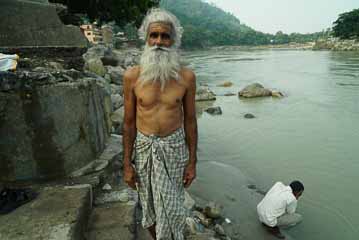
sikh standing