
For those of you following the progress of my film, well, I mentioned last week that I had made a creative breakthrough – and now it’s starting to cascade.
The thoughts and images are coming.
This is a film which will be made in post production. Editing. I’ve always known that. But now I’m starting to realise to what extent that will be true.
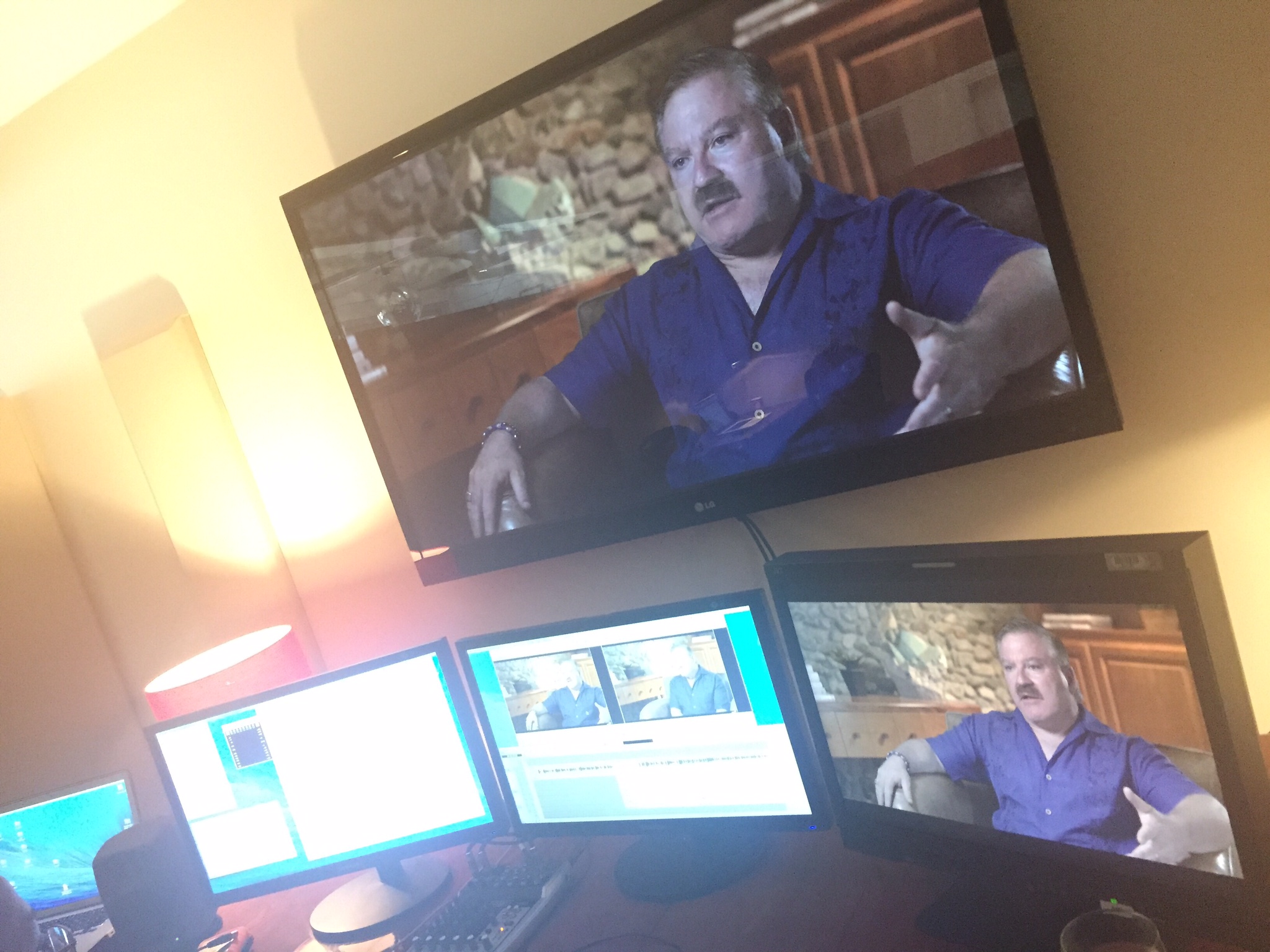
I’m not talking about cutting interviews. That’s the easy part. (Well, we’re into our 4th week now and we’re still cutting those interviews!) But I’m talking about the way the story is told. What I call the delivery system. The aesthetic of the film – the underlying intellectual DNA of the film. That’s what I’ve been searching for. That’s what I’ve been struggling with.
But now it’s finally coming together. I have allowed the film to speak to me, to tell me how best it should be made, and finally it’s begun to have a dialogue with me. And that dialogue excites the hell out of me.
I’m staying with my daughter and her fella in the city part of Sydney, and each day I walk 7kms to the editing room. And after work of an evening I walk 7kms back. I do this to prepare for the Portuguese Camino coming up, but also it gives me time to think.
I’ve found myself listening to podcasts – and I began listening to a series called Serial, podcast by This American Life. I know I’m very late to the party on this one – that it’s been around for a while, and I’ve been aware that when it began it created a cultural furore – huge excitement about the story, but also about the way the story was told.
I have now listened to both Season One and Season Two – and I’ve been fascinated by the mechanics of storytelling within the two seasons. Yes, audio allows you certain liberties not available in film – but I’m talking about an approach to non-fiction storytelling that conventional visual documentary has yet to embrace.
This to me has been the biggest breakthrough in my approach to my film – finding a way to impart information in a way that breaks down the formalism of non-fiction storytelling.
Also –
For quite some time now I’ve been writing a journal of the process of making this film. A whole lot of seriously weird stuff has happened and continues to happen – and I’ve felt that it’s important to keep a running diary.
On one hand it will be an interesting account of the process of putting such a unique film together – but it will also be a wonderful account of how to use your intuition to create something… and the fears and obstacles that present themselves.Because in making the film intuitively, I’ve opened myself up to the vagaries of the Universe, and at times it’s been terrifying, and at other times incredibly liberating.
Anyway, I thought I might now post my entry this morning, which I began writing at 4am after an hour of thinking through my film…
I should also add that I have put REDACTED over certain sections where I talk about the craft techniques I’ll be using in the film. It’s like what the CIA does with transcripts of terrorists at Guantanamo Bay, when they don’t want the world to know they’ve been waterboarding them. Obviously I want to keep this craft stuff private until the film comes out…
APRIL 6
It’s 4 am and I’ve been awake about an hour. My head has been spinning with visual possibilities. And I think I’ve settled on something – something that I’ve been grappling with for some time now, and that is to find a way to impart information in a casual and personal way, without diminishing the veracity of what I’m saying – and yet in a way that enables me to summarise and precis, and comment upon and explain.
Most importantly though, I’ve been trying to find a way of imparting information which enables me to express how I feel, and how I’m feeling about things at certain parts of the story. And that’s what I think I’ve found just now.
It comes back to Serial, and the way Sarah Koenig and her team were able to “jump dots” in their storytelling. What does “jump dots” mean? It means you don’t have to connect all the dots. You can jump dots. You can do the heavy lifting for the audience, and they will not only accept that, they will welcome that because they trust you. That’s the key to it – they trust you. They trust that you’ve done your homework, that you’ve stuck to journalistic principals and truths, and that when you deviate into personal conjecture, which I must in this film, then it’s clear that I’m doing so, and when I’m doing it, and there’s no confusion between objective and subjective.
That I guess is the key to this – what I’ve been trying to do is find a narrative delivery system whereby I’m able to shift between the objective and subjective. And indeed, even embracing the subjective from a personal perspective in a film like this will be bold. And really scary for me too because I’m really putting myself out there.
But it comes down to the ….REDACTED…. with the film, and with me. And what I think and what I feel. I can use this device to comment upon what we’ve just seen and heard, and also to prep the audience for what’s coming up. I can also though use this device to make personal observations, and to do so in a very casual and “street” like manner. A bit like a political commentator.
I’m also thinking about REDACTED use of graphics REDACTED, and also having shifting information REDACTED that’s germane to what I’m talking about.
The audience now has a whole new grammar which they’re using in their ingestion of visual information – a grammar that didn’t exist even five years ago. That’s thanks to social media, and a technology which allows a multitude of different informational streams. Both software and hardware.
And yet conventional documentary non-fiction filmmaking hasn’t adjusted. They’re still speaking in Olde English. There seems to be a belief that in maintaining a certain formality in nonfiction filmmaking, that this imbues the film and the filmmaker (perhaps more importantly) with credibility. And in some cases it does – but it’s old speak. It’s old grammar and language and syntax. The world has turned. There are new and more exciting ways of imparting information.
Particularly with such a complex story as the one I’m telling, I have to find a clear and accessible way to impart information which isn’t alienating, which isn’t confusing, which isn’t soap-box, which is engaging. And real and personal and emotional and revealing.
I’ve learned so much from listening to Serial, and analysing how they’ve told that story. Really examining the very subtle ways they’ve broken the conventions of nonfiction storytelling. I found a New Yorker podcast of an interview with Sarah Koenig, and on my walk to the editing room last week I listened to it – and it was fascinating to hear her talk about her process.
Thing is – we don’t have to do what what’s been done before. That’s the key to it as far as I’m concerned. Listening to a podcast of Lee Carroll yesterday on my walk, (Lee Carroll channels Kryon, and he’s featured in my film) – he said: “You have to get to the point where you trust what you don’t see.”
That stayed with me all day. You have to trust what you don’t see. There’s huge wisdom in that short statement. He also talked about the dirty windscreen, and wiping a patch clean and being able to see out – and the more you clean, the more you can see. That’s what’s now happening with this film – I’m starting to clean larger patches, and I can see more clearly.
Anyway I need now to get back to sleep otherwise I’ll be a wreck in the editing room today.







 PGS - The Way
You must be logged in to post a comment.