Witches up!

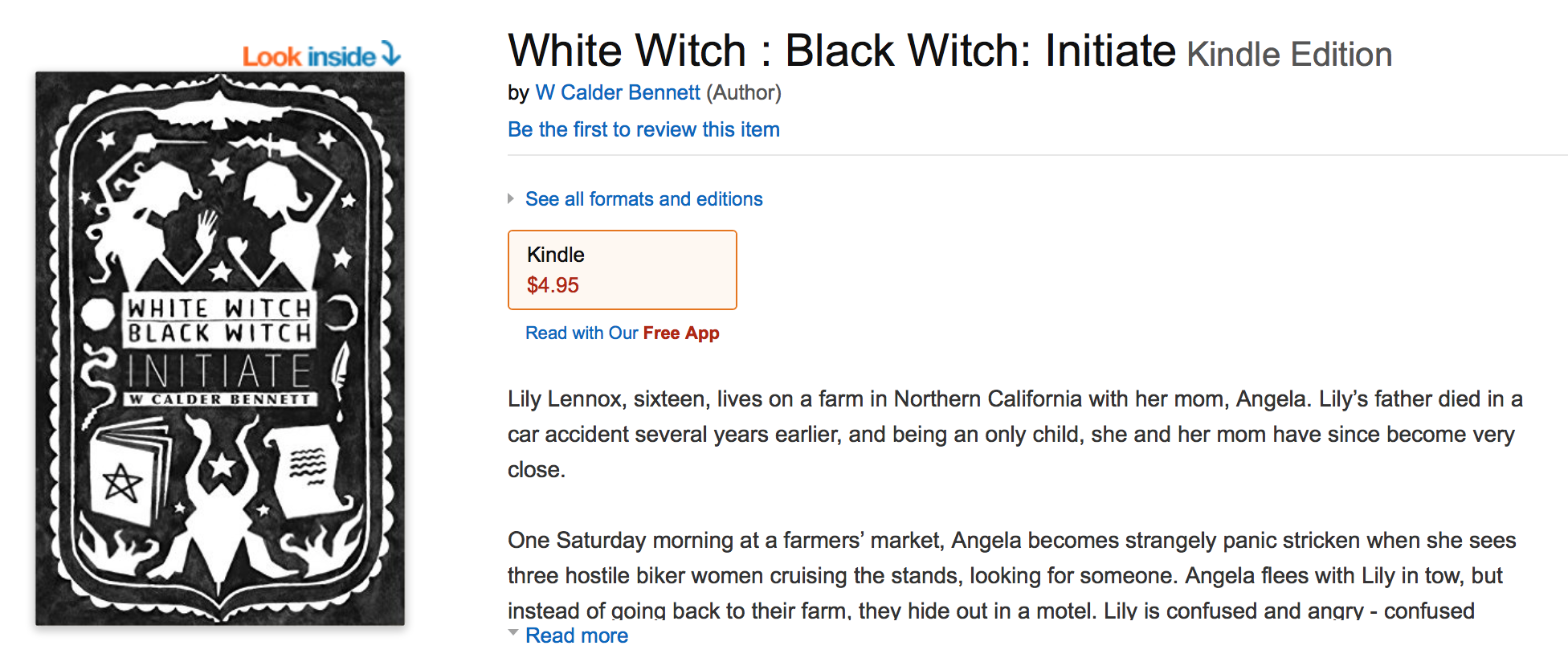
My book, White Witch Black Witch : Initiate  is now available on Kindle.

Here is the book’s synopsis:

Lily Lennox, sixteen, lives on a farm in Northern California with her mom, Angela. Lily’s father died in a car accident several years earlier, and being an only child, she and her mom have since become very close.

One Saturday morning at a farmers’ market, Angela becomes strangely panic stricken when she sees three hostile biker women cruising the stands, looking for someone. Angela flees with Lily in tow, but instead of going back to their farm, they hide out in a motel.

Lily is confused and angry – confused because her mother acted so oddly, angry when she doesn’t explain why.

That night, her mom slips away from the motel and doesn’t return. In the days that follow, Lily learns that her mother has been leading a shadow life, and that she’s been abducted by witches.

Accompanied by a young man, a Native American shaman, Lily sets off to find her mom, but she quickly discovers that the witches are now coming after her too. The only way she can hope to fight them, and rescue her mother, is to become a witch herself.

This is the first of a planned series of four books, which follows Lily Lennox as she becomes a more powerful white witch.

The first book, and the subsequent books, deal with a contemporary world where witches, black witches, have embedded themselves into all aspects of contemporary society, and they act like terrorist cells. They exist in Government, law enforcement, the judiciary, the media, and in big business.

Their mission statement is to use their unique positions of power within these organisations to create fear and chaos in our world, and within that murky soup they can then begin to exert their influence.

This is not a Harry Potter type story, this is set in the real world, in the here and now.

Why did I write a book like this? Well, from a very early age I devoured everything that Ray Bradbury ever wrote, and I grew up with his writing as a major influence. I then segued into HP Lovecraft and Edgar Allen Poe.

That said, I didn’t want to write fantasy – I wanted the story to be grounded in fact and reality, and so before writing a word of this book I researched the world of witchcraft thoroughly – and I discovered that what we know as witchcraft from popular fiction is fairy-tale stuff. The real world of witchcraft is much more sinister, much more insidious, and way more terrifying.

On one level, this book sits within the genres of thriller, action adventure, and young romance – but at its heart this is a book that examines the true nature of good and evil, and the nature of our souls.

The black witches want Lily’s mother’s soul – and the series of books will be about the fight for her soul, and Lily’s soul. To that extent, the book examines themes which are consistent with, and an extension of, my work with my PGS film.

For those of you who asked for a copy, I’ll get them out today or tomorrow.

If you missed the earlier post and you want a copy, email me at billpgsblog@gmail.com. All I ask is that you write a review on Amazon and Goodreads when you’ve finished. The book is only available at the moment on Kindle, but if you don’t have a Kindle you can read the book on any iPad, tablet, smartphone or computer using a free Kindle app.

If you want to buy a copy, then here is the link:

Black Witch : White Witch / Initiate – from Kindle Store

As I said in my earlier post, I will now seek broader publication, and a literary agent. In the meantime though, I want to get it out there. If you get to read it, I hope you enjoy it.

Screenshot 2015-12-08 06.36.19

How they let you know they’re here ~

We were driving to dinner last night. 

Dinner with friends. 

Jennifer and I rarely socialise, but these were long time friends – a prominent winegrower from the district, his gorgeous wife, and a couple who have recently walked the Camino for the first time. All dear friends, and Jennifer and I were looking forward to catching up with them.

Dinner was at the winery – one of the most beautiful wineries in Mudgee, which is a town not short of beautiful wineries. It’s about 20 minutes drive from our house. 

They said 6pm. As we were driving out I looked at the clock and saw that we were going to be early. 

I said as such to Jennifer: I don’t want to be early. We should pull over somewhere and wait. 

My phone rang. It was the security service that monitors our house alarm.

Sir, your alarm has just been activated from the lounge room, they said. 

I quickly did a U turn and drove back to the house. Whenever the alarm goes off, I freak out that someone has broken in. 

No-one had broken in. Jennifer had put our dog in our bedroom upstairs but forgotten to close the door. The dog had wandered downstairs, into the lounge room, and triggered the alarm. 

Whew. 

We put the dog upstairs in the bedroom, closed the door, reactivated the alarm, and drove off again. 

As we were driving out of town, out into the vineyards, I looked at the clock. We would now arrive at about 6:15pm. A good and courteous time to arrive. 

Did you see what happened? Jennifer said. You told the Universe you didn’t want to be early. And then you got the call from the security service. And now we’ll be arriving exactly when you want to arrive. 

She was right. I hadn’t connected the two. I had barely said I don’t want to be early, and I got that call. And now we were on time. 

I got several things from this: 

  1. Your words, and thoughts, are incredibly powerful.
  2. They’re listening, and they’ll do their best to try and do what you want.
  3. You have to be very careful what you say, and what you think – because thoughts are just words unspoken, deeds not yet done. 
  4. They do these little things for you to remind you that they’re with you for the big things too. 
  5. All you have to do is ask, with full intent.
We had a great dinner. Four wonderful friends, beautiful food, magnificent wines of course, great conversations. And as we drove home, I thought about the house alarm incident, about how my wish not to be early had been fulfilled. 
 
You might think it was just a coincidence, and that I’m placing too much significance on something trivial that just happened. But how else do they let you know they’re here, with you, and they’re working for you?
 
Who are “they?” 
 
They’re part of your Personal Guidance System. 


White Witches & Black Witches ~

Next week I will be publishing my first novel.

It’s called White Witch : Black Witch / Initiate. It’s the first of a planned series, and whilst I’ll be self publishing initially, I hope to pick up a publisher. Or a literary agent. Preferably both.

It’s been eight years in the making – and goodness knows how many rewrites and drafts. I’ve had to learn a completely new set of skills. Writing a novel is totally different to any other kind of writing – particularly screenplay writing.

During all the years I worked on the manuscript I told no-one, other than my family, and a few close and trusted friends. No-one else has known that I’ve been tooling away on this story, and developing my craft, for so long.

Finally though I decided to tidy it up and get it out while I’ve got a bit of breathing space with my intuition film. I think I’m going to be very busy next year with the film.

I’m writing it under the name: W Calder Bennett. My full name is William Arthur Calder Bennett. I’m doing this so that there’s a clear distinction between my work as a novelist and my work as a film writer and director, for which I’m known as Bill Bennett, of course.

Here below is the cover of the book. The design was done by a very talented young lass named Cass Gaunson at Carnival Studios, under the supervision of Demi Hopkins. Demi and his team designed the covers of my two other books – The Way, My Way, and Photo Camino. 

For those on this blog, if you’re interested, I’ll send you a Kindle copy gratis once it’s published – probably next weekend. All I ask is that you write a review on Amazon and Goodreads when you finish.

Let me know if you want a copy –
billpgsblog@gmail.com

WWBW_INITIATE_D2

Spiritual, But Not Religious Pt3

Julian Lord, Christian, Intellectual, Combatant 🙂  has replied to my post yesterday –

Here is his wonderful response –

(the sections in bold italics are my previous responses to him…)

tell me if I’m wrong here but what you’re implying is that spiritualism doesn’t employ an intellectual rigour, whereas religion does. That spirituality is diaphanous and lacking in rational thinking, whereas religion is substantiated by scholarship and learning.

No, that’s not at all what I wanted to suggest.

(and BTW I wouldn’t agree with that dictionary definition either)

Cognition has multiple aspects, and I’d think that rigour and rationality belong to methodology not intellect, scholarship and learning to education not intellect.

The distinction I was thinking of is more one of focus, rather than capability. We’re also getting back into that area that my long post of some weeks back was addressing, the one you never saw that got destroyed by WordPress.

If the intuitive is anything, it’s a focus on perception, including both external and internal perception, and as a guidance system, the intellect would be a recipient of the intuition, and so of course should never absent from the intuitive “process”. The intellective focus and its use of intuition is perhaps best described in Descartes’ Discours de la méthode, whereby the intuition is more narrowly focused into a tool of the intellect.

And I think the relationship between spirituality and religion is similar. One can focus on the spiritual to the detriment of the religious, just as one can focus on the religious to the detriment of the spiritual. But I think that each belongs to the other, just as intuition and intellect do, and one could also focus on the intuitive to the detriment of the intellect, or on the intellect to the detriment of one’s intuition.

But I think that wherever one’s own focus might be, it would be a mistake to neglect the other — and it’s that kind of neglect that leads to that sort of bad dictionary definition, or to religion without spirituality.

Again though, it comes down to definitions. I define religion as an organisational structure for those that adhere to a particular set of beliefs about the cause, nature, and purpose of their existence.

I very much disagree. 😉

That definition is more appropriate to a sect of Philosophy, or a political organisation, and I don’t see that there’s anything uniquely religious about its contents.

Atheists often view religion as being nothing more than that, but as we’ve agreed, religion is meaningless without spirituality, and there’s nothing pertaining to spirituality in that definition, which is therefore wrong, or at the very least incomplete.

I’d argue that a religion is an organisational structure for those that adhere to, and practice, a particular form of spirituality.

Not every religion is going to be strongly productive of doctrines and moral imperatives, but even so, these too are either centred on spirituality or they’re meaningless.

But unless you’re some sort of hermit, or otherwise isolated, by choice or otherwise, you’ll tend towards life in community, and a community of those sharing their spirituality is fundamentally religious, even if it might not be “a religion”. Just as the spirituality of the Camino belongs to all pilgrims, and the Camino is a community on pilgrimage.

Religion is intellective, in my view, because it is the organisation of the spiritual into a persistent, community form — to continue the parallel with the Camino, pilgrims tend to all follow along the same path, instead of dispersing each person along his own individual route.

If spirituality is intuitive, then, it is in the individuality of experience and action, whether in or out of community — but we are not alone, and the spiritual community of religion is precious, and not opposed to it.

Monks in procession

Spiritual, But Not Religious Pt2

Yesterday I posted a blog about spirituality versus religion.

It got a response from Julian Lord, who frequents this blog from time to time and is a highly educated, highly erudite Christian.

He disagreed with the thrust of what I was saying, and I began drafting a reply to put in Comments, but then thought that our “argument” deserved a wider dissemination, and so I’ve decided to make it a separate post.

I will first post Julian’s comment to my post yesterday, reacting to my stating that I believe spiritualism is personal, religion is institutional…

I very much disagree — perhaps a better parallel for you to work with, in relation to your work here, would be : Spirituality is intuitive, religion is intellective.

Religion is meaningless if it isn’t also spiritual though ; so that the complementary point, that spirituality is meaningless if it isn’t also religious, is worthy of some very serious consideration.

And my response:

Hi Julian, nice to see you here again.

Of COURSE you would disagree! You are a devout and highly intelligent Christian, and we have disagreed on many things in the past. I value your opinions, as you know, and respect your take on matters spiritual and religious, but don’t personally hold all your beliefs.

Firstly, your point – Spirituality is intuitive, religion is intellective. 

I had to look up the definition of “intellective,” and what I got was – of or relating to the intellect. Intelligent, cognitive, having power to understand. From the same dictionary, the definition of intuitive is: perceiving directly without rational thought.

By the way, as an aside, that is not my definition of intuition. But I’ll save that for my film…

Getting back to your point – tell me if I’m wrong here but what you’re implying is that spiritualism doesn’t employ an intellectual rigour, whereas religion does. That spirituality is diaphanous and lacking in rational thinking, whereas religion is substantiated by scholarship and learning.

To use your term, I very much disagree.

A spiritual person can draw from the writings and teachings of some of the great minds from the past five millennia. A spiritual person isn’t limited in his/her search for knowledge – and isn’t tied to one particular school of thought.

A spiritual person can draw from various religions – and most do – but they’re not necessarily limited to one doctrine. They usually search wider, and include in that search the wisdom of many other disciplines, often pre-dating Christianity by thousands of years.

Most often, these ancient wisdom texts can be highly intellective, to use your term, or they can be reductive, as with Zen Buddhism, yet in being reductive they are no less rigorous intellectually. Study some Zen koans, then study the Rig Vedas, read the Bhagavad Gita, or the Buddha’s discourses in the various Pali Canons – these are works of high intellective value.

Equally, a spiritual person can delve into the complexities of quantum physics, Unified Field theory, and the nature of the universe from a cosmological and astrophysics perspective. Some of our greatest scientists working in this area are spiritualists, because in studying the fundamental nature of matter and the cosmos they’ve come to the conclusion that there must be a God.

Then there’s the mystical element of spiritualism, which involves the study of the processes of cognition, and the nature of the mind, and thought itself. These shift into the areas of clinical and medical scientific research, but also psychology and psychiatry. They also involve the study of philosophy, and those seeking a true spiritual understanding will often delve into these disciplines.

Then we come to the soul. Those who seek an understanding of the nature of the soul can turn to various sources, some of which of course are speculative, but some are again highly intellectual discourses which date back four or five thousand years, and have become the basis of the world’s largest religions.

So to say that spiritualism is intuitive I believe doesn’t give full credit to the depth of highly scholastic and intellectual work that is available to those that wish to follow a spiritual path.

To your point – Religion is meaningless if it isn’t also spiritual though ; so that the complementary point, that spirituality is meaningless if it isn’t also religious, is worthy of some very serious consideration.

Agreed – religion is meaningless without spirituality, however I don’t believe that spirituality is meaningless without religion.

As I said earlier, most seeking spirituality in their lives invariably turn to religious texts – although most often they’re not Christian. Again though, it comes down to definitions. I define religion as an organisational structure for those that adhere to a particular set of beliefs about the cause, nature, and purpose of their existence.

Certainly religion can be, and must be, personal. There is possibly nothing more personal than one’s religious beliefs. But I’m not talking about that aspect of “personal,” I’m talking about the structure of a system of beliefs, and of communion with God.

Religion, in my view, is an “agency,” that helps guide an individual, a community, a society, a civilisation to God. It acts as an intermediary between those people and God, and seeks exclusivity. It professes to “know” God, and seeks to pass on that knowledge. Sometimes it seeks to impose that knowledge.

Most religions believe that because they know God so intimately, their God is the right God, the only God, and there can be no other God but their God. Some believe this vehemently. And so there is war.

Spiritualists, on the other hand, usually believe that there is only one God, irrespective and independent of religious belief. This is regarded as heretical by most religions.

The religion agency has certain rules as part of its Terms of Trade. Each religion has different Terms of Trade, different rules. But usually anyone wishing to use the services of that agency to find God has to adhere to those Terms of Trade.

There are some who don’t want that agency, or don’t like its Terms of Trade. And so they look elsewhere for a more direct and unfettered communion with God. This is why the church so often vigorously opposes spiritualism, because its exclusive arrangement as the sole agent is threatened.

I’m reading Salman Rushdie’s new book at the moment. Two Years, Eight Months, and Twenty Eight Nights. I recommend you read the book Julian. It’s a highly imaginative, and beautifully written metaphor, but at its heart it’s a discourse on the battle between science and religion.

But one of the characters, at one point states: In a thousand years, we will discover that we don’t need religion. 
angle


Spiritual, But Not Religious (SBNR) ~

I’ve been curious for a while about the difference between spirituality and religion.

I’ve come to my own conclusions about the distinction between the two – but I needed a distraction from my work on my intuition film, and so I googled: Spirituality vs Religion.

And what I discovered was quite surprising.

I discovered that there is a demographic category called SBNR – Spiritual But Not Religious.

There’s even a website called sbns.org. Their tagline is:

Love is the answer
You are the question

I don’t actually know what that means. But it sounds good.

The website has posts that link to their Facebook page. Their most recent post was three and a half years ago.

According to my favourite research tool, Wikipedia, SBNR has become a movement. Yes, a movement. Since the 60’s, the percentage of people in America who do not affiliate with a religion but profess to hold some spiritual belief is 25% – and growing each year.

Interestingly, the majority are men, and they’re young. That surprised me.

The reasons for rejecting religion were cited as:

  • it’s too rigid and pushy
  • it’s too institutionalised
  • it’s hypocritical
  • it’s restrictive
  • it’s irrelevant
  • it’s too dogmatic and inflexible

Criticisms of the SBNR movement are:

  • it’s superficial
  • it lacks rigor
  • there’s no sustained dedication or devotion
  • it’s shallow and inauthentic
  • it’s too casual and there’s no formal structure

What’s my definition of the two?

Spiritualism is personal, religion is institutional.

Some people like Starbucks. All the decisions are made for them. A Starbucks coffee is the same every day, everywhere. You walk into a Starbucks anywhere in the world, you know what you’re getting. Coffee from Starbucks is a no-brainer.

Others like to make their own. They like to use their own machine, grind their beans to the consistency they prefer, they adjust the compression of the grind in the head so they get their crema just right. They will go to great lengths to get their coffee just the way they like it. For them, it’s worth the effort, and they would never think of going to Starbucks.

Similarly, the Starbucks aficionados would never dream of making their own coffee. Why go to all that trouble, and expense? Starbucks coffee is great.

Of course this is a very flip and superficial comparison between the two – and I could shift into a more esoteric gear – but not now. That would necessitate me discussing my particular beliefs, and now’s not the time.

Have I ever said to someone: I’m spiritual, but I’m not religious… 

I really hope not. I’d hate to think I was part of a movement…

best of India Bhutan-1-2


Holy Year of Mercy

My good Camino buddy Arlene has just posted this on her blog. We’ll be leading a tour along the Portuguese Camino in May… Thanks Arlene!

Arlèna's avatarChoose Happiness Adventures

cathedral santiagoIn Santiago de Compostela, a year is considered Holy or Jacobean if the 25th of July, Saint James Day, falls on a Sunday.  The Porta Santa (Holy Door), which gives access to the Cathedral from the Plaza de la Quintana is opened on the 31st of December on the eve of each Holy Year, and closed up again a year later.

Holy Years normally fall every 6, 5, 6, and 11 years: the most recent ones were 1982, 1993, 1999, 2004 and 2010.

Therefore, the next Holy Years will be 2021, 2027 and 2032.  However, 2016 will be an important year for pilgrims as it has been declared a ‘Holy Year of Mercy’ by Pope Francis and special events will be taking place.

Santiago Cathedral officials have confirmed the Porta Santa will be open for the Year of Mercy.  As in the past, pilgrims reaching Santiago during a Holy…

View original post 30 more words

It’s going to be a nightmare ~

How often have you heard someone say that:

It’s going to be a nightmare. 

And invariably it is. Because we create our future with our thoughts and our words.

If you think it’s going to be a nightmare, whatever it is, the Universe will try its darnedest to deliver on what you want. So you’ll end up having your nightmare.

Be careful what you wish for… 

When we get together, as family, as friends, our conversations tend to go one of two ways: We either talk about things we like, or we talk about things we don’t like.

More often we talk about things we don’t like, because that’s easier. And it’s more fun. We like to gossip, or run someone down, or tell everyone about someone really awful who did something really bad to us.

And what happens is this – others around us join in, and they try to top our story with their own story of someone even more awful that did something even worse to them.

We do it ourselves. We love to up the ante with our own stories of misfortune. Or stories about someone really horrible.

We gain strength in belittling someone else. At least, we think we do.

Most conversations about politics aren’t about what a great job the government is doing, but about what a terrible job they’re doing. Most conversations about politicians aren’t about what good hard working people they are, but what incompetent self-serving fools they are.

We tend to default to the negative.

I noticed, when I was making tv commercials, a phenomenon that I’ve since encountered elsewhere. It has to do with where power lies within a group of people.

You’d make a thirty second tv commercial, and then you’d have to show it to a boardroom full of agency people and clients. For a director such as myself, it was always a terrifying ordeal. Because so much money had been spent on the ad, and so much more would be spent on buying media time.

There was a lot at stake.

And so you’d show the ad – and there’d be silence around the boardroom. And then someone would ask to see it again. And so you’d show it again. And then there’d be more silence. And then eventually, some brave soul would proffer an opinion.

It’s not bad, they’d say. They wouldn’t have the nerve to say it’s good, but they’d say it’s not bad. But then having broken the ice, others would join in and agree, and say: Yes, in fact it’s quite good. And someone else would agree, and before you know it it’s the best ad they’ve made all year, and most probably will be a finalist at Cannes. And then they’d start to clamour for credit for the good work.

And then someone in the corner would quietly say: No, we have to recut it. It’s too slow. And our product isn’t on the screen for long enough. It’s a mess.

And then everyone would murmur and agree that yes, it was a mess, and yes, it was too slow, and yes, the product wasn’t on the screen long enough. These were the very people that only moments ago were proclaiming that it was going to win prizes at Cannes.

And so I discovered this:

That power lies with the most negative person in the room.  

And so it is with our conversations in coffee shops, at dinner parties, at a bar. We derive pleasure from wallowing in the negative. Because it draws attention to us. Those around us feel sorry for us, and coo their sympathies. Or they applaud us, and think we’ve got balls for standing up for our rights. Or telling that dickhead that they were a dickhead.

It’s a habit that’s very easy to get into.

But interestingly, you rarely hear these kind of negative conversations on the Camino. You hear people talking about what a wonderful day they just had. Or about the amazing person they just met. Or how a stranger was so kind to them…

As I say, it’s a very easy trap to fall into – slipping into conversations that accentuate the negative. Next time you find yourself doing it, step back and ask yourself: Can I change this around and say something positive?

Try it, and see what happens…

bodies

INTUITION //: Your Personal Guidance System

I have the title of my film –

I’ve been agonising over this for a long time.

I’ve gone through various options, and with some guidance, I’ve come back to this –

INTUITION //:
YOUR PERSONAL GUIDANCE SYSTEM

© Bill Bennett

Obedience ~

I went to mow the lawn yesterday.

It takes me 2 hours to mow our lawn, and so I usually listen to music, or an audiobook, which I crank up loud so I can hear it over the scream of the lawnmower.

When I made a commitment to spiritual development, a while ago now, I decided I would reduce my reading of fiction – which I love – and prioritise books on things spiritual.

Since then, I’ve read a few fiction books – often on planes – but largely I’ve been playing catch-up on the kind of books that Jennifer has been reading for the past twenty five years or so. Books such as the I AM series, the Kryon books, A COURSE IN MIRACLES, books by Emmet Fox, Caroline Myss, Alice Bailey, James Van Praagh, Norm Shealy – and so on. Not to mention Jung, Daniel Kahneman, Fritjof Capra – the list just goes on and on.

So much to read.

I do a lot of my reading while I walk, on audiobook. But sometimes, reading esoteric books while I walk is just too much.  I tried reading A COURSE IN MIRACLES on audiobook while I walked, sometimes with traffic thundering past, and I couldn’t get into it. It was too dense. With a book like A COURSE IN MIRACLES every word is important.

I’m reading a book at the moment called THE HUMAN SOUL REVEALED, by Monika Muranyi. It’s a compilation of Lee Carroll’s channeling of the entity Kryon. As it’s title states, it’s about the nature of the human soul, and how it all works. It’s fascinating.

Back to the mowing.

I’d decided that because I’m reading that book at the moment at night, I’d read something lighter while I mowed the lawn. So I put the latest Stephen King audiobook on my iPod, and cued it up to start at Chapter One, and then I went outside to mow the lawn.

I started up the lawnmower, and then I pressed play on my iPod, and up came…
… the Bhagavad Gita, translated by Paramahansa Yogananda. I’d put this audiobook on my iPod a while ago, but hadn’t yet got around to reading it.

But hang on, I’d cued up Stephen King.
What just happened?

Your interpretation could be that it was just a technical glitch, or I’d simply made a mistake and hadn’t cued up Stephen King properly, and the iPod had just randomly selected the Yoganada book.

My interpretation is that the Universe kicked in and told me that I was wasting my time reading Stephen King, and that I had to read the Bhagavad Gita, through the eyes of Paramahansa Yogananda. (He’s the guy that wrote AUTOBIOGRAPHY OF A YOGI)

I didn’t see it as a technical glitch, or a mistake – I regarded it very clearly as a directive.
As a sign.

The thing about signs – you can either rationalise them and dismiss them, and refuse to see them for what they are – or you can recognise them as being a part of your guidance system – your personal guidance system. It’s your intuition working in discreet ways to keep you on your path. Your guides ask you to follow, and you have the choice to ignore them and get on with your life, or obey.

Obedience.

It’s not a comfortable word, is it. It has the connotation of giving up something. Losing status. Taking a subservient position to someone or something else. Handing over your power.

But what if this power is yourself? Your divine self. Your intuitive self. What if you’re being asked to obey your innate wisdom? That wisdom within which knows better than you.

The other thing about signs, about intuitive prompts, is that for the system to work effectively, you have to exercise it. And like with any exercise, it’s always best to start off small.

If you wanted to get fit you wouldn’t begin an exercise program by running a half marathon, would you? You wouldn’t go to the gym and try to lift three hundred pounds.

Same with your intuition.

Start off small. Ask for guidance on little things.

Should I go to the Post Office this morning or this afternoon? Should I call Mary for a chat?  Should I take a raincoat to work today?

Ask yes or no questions. Listen to the response. See what comes back. Feel what comes back. Note what happens as a result of your decisions. Start a dialogue with your intuitive self.

Soon, maybe sooner than you think, your intuition will start to talk too. And you might be surprised at what it tells you to do.

I didn’t listen to Stephen King yesterday. I listened to Yogananda’s take on one of the fundamental texts of spiritual learning.

I turned it up loud so I could hear it over the lawnmower.

Mower