PC #66 – Fear of Lack

This blog follows on from the blogs on hoarding –

Fear of Lack – 

We all suffer from this fear. Probably even Rupert Murdoch suffers from it.

One of the greatest fears of lack is fear of lack of money. That’s a big one for a lot of us. There’s an argument to be put that fear of lack in fact is a positive motivation for you to get out and do things – to be more productive.

That it spurs you to create, and that it’s like a cattle prod that kicks you into gear, or keeps you energised. Keeps you focused.

I don’t agree with this.

Then there’s the fear of lack of love. We all have this fear too. We have a need to be loved. But some of us fear that love being withdrawn from us – through death, or through separation, or because we don’t trust it. And so we push it away.

We push away those that are trying to love us, because we don’t read the signals right, or they don’t express their love in a way that we understand, or can fully appreciate.

Then there’s the fear of lack of potency. This is most clearly reflected in our being scared of growing old. We hanker for our youth, when we believe we were at our most potent, whether that potency is reflected in physical strength, our capacity to love, our capacity to provide for those that we love, our capacity to be capable and competent.

At the basis of this fear of lack is our mistrust that we will be provided for, that we will be nurtured, that everything will be okay. Perhaps we’ve had some bad experiences, and it’s tarnished our glass-half-full approach to life. We now see the glass as being cracked, and leaking like a sieve.

Rupert Murdoch I suspect might wake up in the morning, in luxurious surroundings more magnificent that we can ever comprehend, and he might have gnawing fears just as we do. Does his wife love him (clearly not), do his children love him (depends on his how his will is written?), is he getting too old to run his company proficiently, are his shareholders happy with the way he’s running things?

None of us, no matter how rich or powerful, are protected from our fears of lack.

I have written this before but I’ll write it here again – and I believe this most powerfully:

WE ATTRACT WHAT WE FEAR THE MOST

If we fear lack of money, then we’ll go into lock-down mode. We’ll become tight and defensive, we’ll be anxious, we’ll become moribund with fear, we won’t spend, and we’ll close ourselves to opportunities and possibilities.

Our anxiety and our fear will push people away from us. Some of those people could be existing clients, or people offering business opportunities. But who wants to work with someone who’s always uptight and scared of being poor?

As well, our fear mentality will close down our creativity, and our capacity to produce and originate new ideas, new products. In other words, we will attract what we fear the most – we will attract a diminution of income streams. We will lose money, we will lack money, because that’s what we’ve feared.

Same with love.

If we’re scared that we won’t be loved, or that we’re not loved, then we’ll become aggressive, or maudlin, or we’ll lose sight of our true nature and try to be something we’re not so that we can grab or cling onto the love that we seek. And in doing so, we’ll push away that love. It won’t come near us.

Who wants to love someone that believes no-one loves them?

Same with potency. We all grow old. We all lose our physical strength, our youthful good looks. Our bodies lose their firmness, our skin becomes wrinkled. There is nothing we can do about this, other than stave it off for a while with cosmetic surgery. But that’s just the outside. There’s no cosmetic surgery for growing old on the inside – for holding onto crusty old fashioned beliefs. For thinking we’re old.

The only way to combat that is to change your thinking. See yourself as young, as being potent. Work a little harder to keep up with things. Don’t allow yourself to become old. You can make a choice in the morning. Are you going to wear jeans, or are you going to wear track pants?

Think about that.

What the Camino teaches you is that you will be provided for. It will keep you safe, housed, fed, loved. You will have everything you need. Unless you believe in lack. If you believe in lack, then you’ll get lack.

Isn’t it better to believe in abundance? Someone once said – Enough is as good as a feast. It’s the kind of pithy aphorism you used to find on daily desk calendars. But it’s actually true.

Enough is as good as a feast.
DSCF4250

Spam sorted – hopefully!

Hi all –

horrible spam attack tonight. I got into the spam filter settings in WordPress and tightened them up – and hopefully now that’s put an end to it.

Apologies though if you got inundated with email notifications –

Although I guess it wouldn’t have been a problem if you wanted to buy a Hermes bag!

Again, sorry for that –

Bill

Apologies for spam!

The blog is being bombarded by spam tonight.

I've been doing everything I can to block it – but it still keeps getting through.

I'm very sorry for this – will keep trying to find a way to stop it. It's getting late here in Australia and I'll be hitting the sack soon – in which case I'll follow up again tomorrow.

There is a spam filter on this site, but obviously it's not powerful enough to stop this particular spammer.

It's driving me nuts.

Sorry.

Bill

PC #65 / 2 – my plastic bag fetish redux

Just to expand on the previous post –

I came back from the Camino eschewing plastic bags not so much for environmental reasons – although I think plastic bags are incredibly damaging, and in the oceans are killing all sorts of sea life.

No, my reason for not collecting plastic bags anymore was because I’d lost my fear of lack. 

I think fear of lack is at the heart of hoarding – you collect things, or hoard them, because you think there’ll be a time when there won’t be enough of whatever it is you’re squirrelling away.

It is like squirrelling – squirrels put nuts and food away for the winter – for a time when they know there will be a lack of food. In that instance, it makes a lot of sense. It’s been programmed into their survival DNA to keep the species alive.

Hoarding plastic bags doesn’t keep the human species alive. But it does stem from a fear of not having something when you believe you’ll need it.

What the Camino does is it forces you to face that fear.

You can’t hoard on the Camino – it weighs too much! The wonder of the Camino is that it makes you consider everything you’re carrying. And if something is unnecessary, then invariably you ditch it, because it’s additional weight.

The other wonder of the Camino is that it does provide. You learn to trust that when you need something, it will be there for you. You just have to trust.

So I came back from the Camino having lost that fear, and gained that trust.

bread


PC #65 – my plastic bag fetish

I used to collect plastic bags.

I never threw out a plastic bag, and so consequently I had a closet full, and several drawers too. Stuffed into the smallest of crevices in the kitchen and laundry.

I was a plastic bag hoarder.

I never knew when I'd need a plastic bag, and I never wanted to be left short.

I used plastic bags the way other people used shoulder bags. I used plastic bags when I was travelling, instead of a toiletry bag. I used them to keep my dirty washing in, and to stuff into the sleeves of my jackets when I packed them into suitcases. A little trick to prevent wrinkles.

Just in these few sentences, you can get some idea of the multitudinous uses of plastic bags. Is it little wonder then that I hoarded them so assiduously?

All that came to an end though when I came back from the Camino.

I no longer had an irrational need to keep several hundred plastic bags in a cupboard where, by rights, saucepans should have resided.

I can't tell you the exact moment on the Camino when I shed myself of this need to collect plastic bags. I do know that during the walk, on the odd occasion I stayed in a swanky hotel, I did collect feminine hygiene plastic bags.

They were just the right size for my toothbrush.

Anyway, it's one of the great mysteries of the Camino for me – that I came back no longer needing to hoard plastic bags.

I'd like to tell you that I took all my plastic bags into the back yard and had a ceremonial burning. That didn't happen. There were so many I was afraid I would have burnt down the house.

But my wife and I have been slowly using them up, and soon there will be none. And I will feel a free man once again. Thanks to the Camino.


PC #64 – Is the Camino safe?

I’ve been to some hairy parts of the world –

The gangland areas of East LA, the projects of New Orleans, the black areas of Baltimore, the drug infested slums of outer Amsterdam, the back streets of Tijuana in Mexico, Port Moresby in Papua New Guinea (a very scary place), the immigrant slums of Lyon in France, the outlying slums of Addis Ababa in Ethiopia, the inner slums of Old Delhi, the Burmese jungles of the Golden Triangle, where most of the world’s heroin is produced, and Harlem late at night, where some of it is used –

I’ve walked through all these places safely, thanks to my PGS.

And I walked the Camino de Santiago safely, too.

But there were a couple of times when I was made acutely aware of just how vulnerable you are as a pilgrim walking the Camino, even being a man.

Often you’re walking alone, early in the morning or sometimes in the dark. You’re often on very isolated stretches of track, out in the woods or beside lonely roads where you’re very visible to the odd passing car.

You’re wearing a heavy backpack which makes it hard for you to cut and run, should you need to. And often you’re exhausted. It’s difficult putting up a fight when you’ve just walked 25kms.

I remember walking out of Pamplona early one Sunday morning. It was about 5:30am, it was dark, and there were groups of late night revellers wandering the streets. Some of them looked at me, and a few yelled out, jeering. They were drunk.

If it had been Sydney at the same time of the morning, in the dark, I’d have been worried about my safety. In fact, I probably wouldn’t have been out walking. Sydney can be very dangerous in the city, particularly on a weekend in the wee hours.

But in this instance, in Pamplona, nothing happened.

Two men followed me for a while early one morning as I walked through some deserted inner city streets of Ponferrada. Foolishly, I’d just stopped and pulled some cash out from an ATM. Really dumb, at that time of the morning. I finally stopped and turned and glared at the men, and they disappeared.

That’s the sum total of my uncomfortable incidents during my Camino.

However, I’ve heard of instances of women being harassed by men while walking on lonely stretches of track. And I’ve heard of one or two muggings.

Over the years, I’ve travelled extensively in Spain – not only on the Camino, but in and around Madrid, and through Cataluna. And I have to say that I’ve found it to be one of the safest places I’ve ever been. After all my travelling around the world, my PGS is now very finely tuned to the approach of danger. And I’ve always felt very safe in Spain.

But being a pilgrim and walking the Camino de Santiago doesn’t give you spiritual immunity from the vagaries of man. Remember you’re walking through a country that’s going through very difficult economic times.

Unemployment is very high, particularly amongst young people. And wherever there’s poverty and desperation, there’s the propensity for crime.

I’ve always maintained that you must walk the Camino without fear. That said, it’s best to be careful, just as you have to be careful anywhere.

Cig butts

PC #63 – Who owns the Camino?

This might be a provocative blog for some –

I ask the question: Who owns the Camino? 

I ask this question because the Camino de Santiago is often described as a Catholic pilgrimage. Does the Catholic Church lay claim to the Camino?

Certainly Spain is a predominately Catholic country, and the majority of pilgrims who collect their Composetla are Spanish.

But does the Catholic Church have a franchise from God to run the Camino?

I thought the people who walked the Camino owned the Camino. Irrespective of faith or belief.

I will now quickly climb into my bomb shelter and await your response…

wpid-Photo-12052013-447-AM.jpg

PC #62 – The Story of my Steak

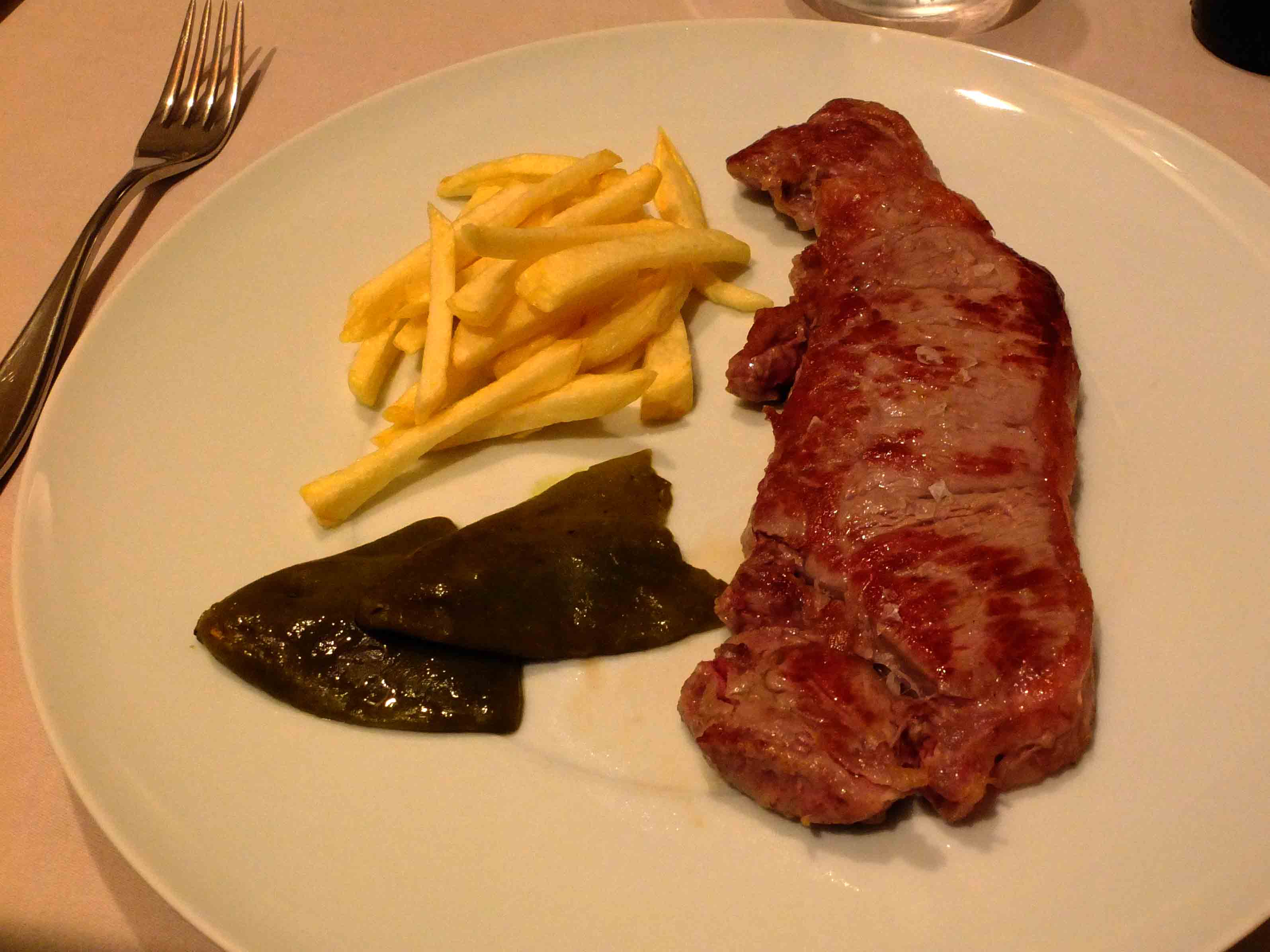
This is the story of my steak.

All I wanted was a steak.

I’d just walked into Arzua, and this would be my last night on the Camino, because tomorrow I intended to walk 39km into Santiago.

So I wanted a big fat juicy steak. Not the kind of thin measly slice of meat they gave you in the pilgrim dinners. I wanted it grilled, and thick, and oozing with blood.

I wanted a Fred Flintstone steak.

So I asked at the front desk of the hotel I was staying in. Yes, for my last night on the Camino, I’d got myself a private room in a hotel. The people on the front desk told me of a place out of town – they did steaks. It was an asador. I knew enough Spanish to know that an asador was a restaurant that specialised in grills.

So sending me to an asador was a good start.

They gave me a map, and off I set. It was mid afternoon, and I hoped this place was still open for lunch. I followed the directions that were drawn on the map, and after about 2kms I thought the people in the hotel must have made a mistake.

I was walking out of town, and it looked like I was on the very outskirts. There were hardly any buildings around. Plus I was sore from the day’s walk. I didn’t want to add any more to my day’s mileage count.

But I kept walking, and in the far distance I saw a cluster of buildings. As I got closer, I saw that one was the asador. It didn’t look much though from the outside. You could have walked right past it and not known it was a restaurant.

By this stage it was nearly 4pm – and I didn’t want to have to come all the way back for dinner if they were closed for lunch. But they were still open. There were a couple of locals inside, at the bar.

The restaurant looked promising. It was dark, for a start, and there was a huge wood fireplace up against the wall, where they did all their cooking. There were hams hanging above the bar, and pictures of cows and bulls on the walls.

This was a good sign too.

The restaurateur came up and said they were closed, but I said all I wanted was a steak. Just a quick steak. He hesitated, and saw that I was a pilgrim, and he nodded. Okay, he said, what sort of steak do you want?

The only Spanish I knew for steak was Chuleton de Buey. Which I found out later means big fat enormous bloody steak. or thereabouts.

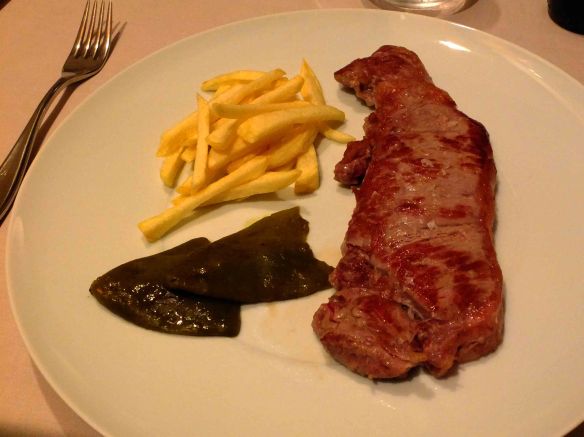
The restaurateur nodded, then he went away and came back with a raw chunk of meat that looked like it had just been carved off the side of a monster cow. It almost required two men to carry it. Or a wheelbarrow. He produced a set of scales and on the table in front of me, he weighed it. 2.8kgs.

I was hungry, but not that hungry. I couldn’t eat a chunk of meat that size.

So I shook my head and said smaller. He took it away, straining under the effort, and I heard some sharpening of knives out the back, then he came back a short time later with the chunk of meat cut down to a more edible size. Again he weighed it, and the weight was now 1.6kgs.

It was still huge, but by this stage I was starving, so I nodded and said Sure, that’ll do, thanks. 

So I watched as he slung this big piece of Chuleton de Buey onto the open grill over the wood fireplace. I could smell the meat cooking, and it made my mouth water.

The men at the bar looked over at me, said something amongst themselves to cause them all to laugh, and then they left. I was the only person in the restaurant.

I ordered a bottle of wine and began to quench my thirst while I waited for the meat to cook. It didn’t take long though because the restauranteur soon took the meat off the grill and brought it over to my table on a plate.

It was so large it spilled over the sides of the plate. It really was a Fred Flintstone steak.

He then produced a gas fired cooker which he placed on the table in front of me, and a cooking pan, and told me I had to cook it myself according to how I liked it. He cut the meat into thick slices, and left me to it.

So, I sat in this huge dark empty restaurant, and I cooked myself the biggest most delicious steak I have ever had in my entire existence.

I’ve had some great steaks in my life – in Chicago, in New Orleans, In Tokyo, and in Finland. Although that steak in Finland was reindeer. The Chicago steak had been the all-time champeen of the world, but this Chuleton de Buey knocked it out of the park.

It took me about an hour and a half to finish it off. And at the end of it, the restauranteur brought over a bottle of home-made grappa, poured me a glass which he said was “on the house,” and walked off to prepare the restaurant for the evening dinner arrivals.

He made the mistake of leaving the home-made grappa bottle on the table.

I don’t remember finishing it. I just remember marvelling at how quickly high alcoholic liquor evaporates.

The bill finally came, and it was €68.

Why did I think it might have been €18 – €20 tops? It wasn’t. It was €68. That’s why those guys at the bar had been laughing.

Luckily he didn’t charge for the grappa. That was on the house.

I stumbled back to the hotel, the bottle of home-made grappa warming my blood, and making it very difficult to cross roads safely.

And the following morning, thanks to the grappa I didn’t need any Ibuprofen for my knee. And thanks to the steak, I didn’t need to eat for a week.

Asador

Steak 1

Steak 2

Steak 3

PC #61 – Things Unexpected

There were things I discovered on the Camino that came as a complete surprise to me –

For starters – Cuckoo birds.

I had no idea there were so many Cuckoo birds along the Camino.

When I first heard a Cuckoo bird, I couldn’t believe it. (I think it was when I was climbing up the Pyrenees, and it’s a wonder I heard anything above my thumping heart!)  But I thought you only heard Cuckoo birds in Bavaria, or Switzerland.

In fact, if someone were to ask me what sounds did I associate with the Camino, then I’d have to say Cuckoo birds, and cowbells. The sound of cowbells was everywhere too, which again surprised me.

And storks nesting in church belltowers. I’d seen that in Alsace, and in parts of Germany too – but it came as a surprise to see it in Spain.

What else was unexpected? The generosity of spirit.

I’d read that the Camino engendered this kind of thing, but I saw it regularly first hand, and was a recipient of “random acts of kindness,” and generosity, several times. People gave me things which I never asked for, but needed. People helped me when I needed help – and sometimes when I didn’t even realise I needed help.

The level of generosity was unexpected.

But perhaps the biggest thing that surprised me, that was unexpected, was the injury toll I witnessed daily. I didn’t expect to see so many people with bad injuries.

I’d researched the Camino thoroughly before I left – and so I knew about blisters and tendonitis etc… but I was astonished to see just how many people were suffering each day with physical problems. And early on in the walk, too.

It’s understandable, I guess. It’s a long way over rough terrain, and many pilgrims come unprepared – with footwear that hasn’t been properly worn in, or is ill-fitting. Or, their backpacks are too heavy, or they haven’t prepared their bodies for the ardor of the walk.

But it was unexpected, because it seemed like there was a conspiracy of silence. Pilgrims didn’t want to post on blogs or forums that they were doing it tough, because it might appear like they were pussies.

I was a pussy. I didn’t mind whining. I still whine.

Last thing that was unexpected – I didn’t expect everything to be so cheap.

Coming from Australia, which is a very expensive country, I was very pleasantly surprised to discover that you could have a great three course meal for €10, including wine. You could get a coffee for €1, or sometimes less. A coffee in Australia is $4.50. That’s nearly €3.

An equivalent three course meal in Australia, in a pub say, with a carafe of wine would set you back $50, easy. That’s €34. So in other words, food in Spain was a third of the cost in my home country.

That was nicely unexpected.

What did you find on the Camino that was unexpected?

wpid-Photo-04052013-553-PM.jpg

Ole! Or How I Became a (Gulp) Kind of Fan of Bullfighting – Day 23 – Terradillos to Sahagun

Other than Steve McCurry’s photographs, I haven’t reblogged another blog – but this deserves to be seen.

Kathy has beautifully expressed the dichotomy an outsider feels on going to a bullfight for the first time.

I attended a bullfight in Seville several years ago, and I found it both exhilarating and deeply disturbing.

Bill

Kathleen Foote's avatarFoote Loose and Fancy Free

Dear Reader, please don’t get your panties in a knot.

There are two things I know to be true about bullfighting:

a.) Bullfighting is growing in unpopularity in those countries where it is most popular – Spain, Mexico, some Central and South American countries.

b.) It is firmly planted in Spanish culture.

And I suddenly had the chance to see a bullfight in Sahagun.

I had arrived in Sahagun early. I had been hearing about the festival of San Juan de Sahagun and seeing posters about the bullfight for several days. In Fromista, a local resident had thrust a flyer in my hand, urging me to see the bullfight since I was heading for Sahagun.

My initial reaction was – Ugh! Bullfighting is a blood sport. The bull doesn’t stand a chance, doomed the moment it sets hoof in the ring.  Why would I want to watch someone put…

View original post 779 more words