Age & Risk

I had a very interesting conversation yesterday over New Year’s Day lunch with a family friend who’s a quantum physicist. We talked about age and risk. He argued very strongly that as you get older, you should take more risks because you have less to lose.

This bloke has his doctorate in Quantum Physics, he lives and works in Canberra and he’s at the cutting edge of quantum research. In his spare time he goes rock climbing. Like, hanging upside down four hundred feet off the ground clinging to the sides of a vertical cliffs with his fingernails.

I asked him if he ever got scared. He said yeah, all the time. But that’s the joy of it. That led to the conversation about risk profiles and age. Here’s a tidied-up transcript of the conversation:

PAT: Well, the theory centres around the fact that most people in their lives front load the majority of the risk to their younger years – then as they age, they risk less and less, even retreating into boredom and monotony as they get older, where the only risk is just time itself. That time is running out.

The average age of death for males in Australia is, what, 81 years. And so the idea is that you should, in fact, be risking more as you age, doing riskier things that you might die from, that give you some kind of exhilaration or life experience that has some value to you. Because when you’re 70, you’re gambling 11 years of your life to do this thing. If you do that thing when you’re 20, you’re gambling 61 years.

How much is time worth compared to the payoff of doing the extremely dangerous thing versus the possible outcome of you ceasing to exist? Not necessarily dangerous, but risky. So it could be financial risk, could be any kind of risk. But a lot of people just front load that, and then the last years of their life, they don’t take any risks at all, when the consequences become quite small.

I see this happening with people doing bucket lists when they’ve got some relatively short term life-threatening diagnosis or something. But then again I guess there isn’t even a risk then, is there? Because they’ve left it so late there isn’t actually anything on the table. Whereas if you decided to do that 10 years earlier, just on the chance, hmm? You’ve got so much more potential payoff if it all goes well.

Take the Camino. Somebody who’s got a heart condition at age 65 decides to walk the Camino. They’re gambling 81 minus 65 years – 16 years. The risk is that they’re going to die on this long walk. But if they don’t die, then the payoff could be huge. It could transform their lives. The walk could, in some way, heal them. Or prove that the doctors might have been wrong and you’re not as ill as they thought you were.

It also comes to the fact that life is very nonlinear in time. Some of your time is very short, and some of it’s very long, but the clock ticks at the same rate, all the way through your life. But it doesn’t in your head. So when you’re on the Camino, right, that could be a valuable time in your life.

Let’s say you do the walk in a month. You could have spent that month sitting on your couch at home. That would be the safe option. That would be the less riskier option. But sitting at home on your couch, have you gotten a month’s worth of value out of it? Whereas spending that month walking the Camino, taking the risk that you could die from heart failure, during that month you’ve experienced joy, a sense of achievement, you’ve made new friends, perhaps you’ve taken on new ideas.

Perhaps at the end of that month you’ve become a different person.

That one month walking the Camino, as against sitting at home on the couch, might be worth six months, twelve months. More. It’s all very nonlinear.

People should gamble more as they get older. But they don’t. They tend to withdraw. They tend to… sort of cocoon themselves. They tend to increase their protection levels, don’t they? They get comfortable, and I think a lot of society says that you’ve earned the right to be comfortable. Like, that’s what retirement is. You’re safe. There will be no big changes because you’ve done everything right. Because you’ve fought your way through life up to that point. But then… why?

Now, you’ve retired and you’ve got 20-maybe 30 years of doing nothing. Why not make that a time for taking risks – doing exciting things? The clock’s ticking down. And you’ve got less to lose. Instead of withdrawing as you get older, why not take some huge risks?
As a Filmmaker, what I’ve learned watching The Ashes ~

For those of you who follow this blog and don’t know what The Ashes is – it’s a series of five games of cricket played between Australia and England. Each game can last five days. At its fullest, that’s 25 days of cricket with each day beginning at 10:30am or thereabouts, and finishing at 6pm or thereabouts. For cricket-tragics such as Jennifer and myself, we try not to miss one minute, one ball, one run.

The Ashes dates back to 182. That’s 143 years. Australia has won The Ashes 34 times, England 32 times – with 7 drawn matches. To say that the rivalry is fierce is like saying the South Pole is chilly.

We’re talking Colonialists versus Convicts.
Need I say more?

I’ll keep this summary of The Ashes, and indeed cricket itself, at this superficial level because cricket is an inordinately complex game. It has its own language, its own arcane protocols, even the naming of field positions defies rationale or logic.

Cow Corner?
Silly Mid Off?

The Ashes are played every two years, or thereabouts – alternating countries. This series is being played in Australia. Prior to this series starting on November 21st, the English press and the team itself declared that finally they had a group of players that could win The Ashes on Australian soil – a feat rarely done.

They derided the Australian team as being old and passed it, sub-par, they called our cricketers Dad’s Army.

The English were bringing to the series a form of cricket that’s become known as Bazball, a highly aggressive form of the game drawn from the shorter, showier form known as T20. In other words, they were attempting to modernise Test cricket, and in the process write their names into the history books.

It didn’t work.
They lost the first three games 3-0 and Australia retained The Ashes.

The 4th game, played in Melbourne last week, they won using, at times, Bazball tactics. But it was too late. Australia had won The Ashes.

I watch a lot of sport because it tells me a lot about the human condition, about courage and timidity, about how to win and how to accept failure, about hubris and grace.

The final chapter is yet to be played in Sydney starting next week, and even though technically it’s a dead rubber, there’s still a lot to play for – reputations, future places in the respective teams, jobs on the line. And history. With each Ashes game history can be made, or rewritten.

I’ve learned a lot as a filmmaker from these first four games already.

  • Preparation. Pundits say England lost the first three games because of a lack of preparation. This, I believe, came down to hubris. They believed they had a winning formula in Bazball. They believed their team was stronger. They thought they didn’t need to prepare. Dare I say it, they were arrogant.
  • Lesson. Making a movie is all about preparation. As a director, by the time cameras roll on the first day of principal photography, 95% of your work should have already been done. You can’t skimp on preparation. And you certainly can’t be arrogant. Arrogance will cold-cock you every time.
  • Patience. Interestingly, listening to the commentaries as I have, and the analysts on various podcasts, the word patience has come up time and time again. Bazball eschews patience. It’s a form of the game that requires a batter to pretty much take a swipe at anything. Test cricket requires, at times, immense patience. And that patience more often than not is rewarded with a long innings and a big score. Conversely, a lack of patience often brings a batter, and bowler, undone very quickly.
  • Lesson. Making a feature film also requires immense patience. I have stood out in a field for more than an hour many times during my working life, with a full crew on alert, waiting for the right light to get a shot. I have waited a mind-numbing length of time on more occasions than I care to remember for ambient sounds to clear so that we can record a perfectly clean dialogue scene. You need to have the patience of a zen monk to be a film director. That’s why I’d be dreadful doing television. Television doesn’t allow for patience.
  • Quite. I’ve noticed that that English coach and captain have used the word quite quite a bit in interviews. We didn’t quite get it right, they would say, Or We didn’t quite get enough runs today. This word quite, used as they’ve used it, provides an insight into their mindset. It speaks to me of delusion and entitlement. Didn’t quite get it right? Mate, we blasted you off the field. Didn’t quite get enough runs? Buddy, we beat you in two days. Their use of the word quite tells me they aren’t facing up to reality. And they really do believe they’re entitled to win.
  • Lesson. As a film director, you need to be grounded at all times. It’s so important, especially early in your career if you’ve had success. It’s so easy to get a distorted view of your own capabilities. You start believing your own publicity. When you’re making a movie, it’s critical that you remain humble and aware that at any stage, you could make a career-ending decision. Of those directors who get to make a first film, only 36% get to make a second film, only 8% make five or more films, and only 0.1% make 20 or more films. I’ve directed 17 feature films which puts me at 1%. That makes me quite humble…
  • Expectation vs Process. The English arrived on our shores with big expectations. They were going to crush us. We had a weaker team – the worst since 2010, said Stuart Broad – and they said that they were going to climb the Mt Everest of cricket. They were going to go home with The Ashes. The Aussies (other than Glenn McGrath, who traditionally predicts an Australian whitewash of the Poms) remained quietly confident in their process. They didn’t think ahead. They trusted in process.
  • Lesson. I know from forty years of making movies that on those occasions when I’ve thought I’d made a winner, I’ve always been disappointed. And also, when I’ve deliberately set out to make a commercially successful film, invariably I’ve failed. Yet the times when I’ve made a movie simply from a) the desperate need to tell that particular story, b) a desperate desire to have fun with the mechanics of cinema, or c) a deep sense of knowing that this was a movie that I would enjoy watching – on the relatively few occasions when that aligned, then surprisingly the films did (quite) well. In other words, I’ve learned to distrust expectations, and to go into a movie merely for the pure joy of making that movie, trusting that the outcome will be what it will be..

These are just some of the lessons I’ve learned. And many more as well – too many to elucidate here. Elite sport for me provides useful lessons in human psychology. I just wish I had the wisdom to interpret those lessons at times.

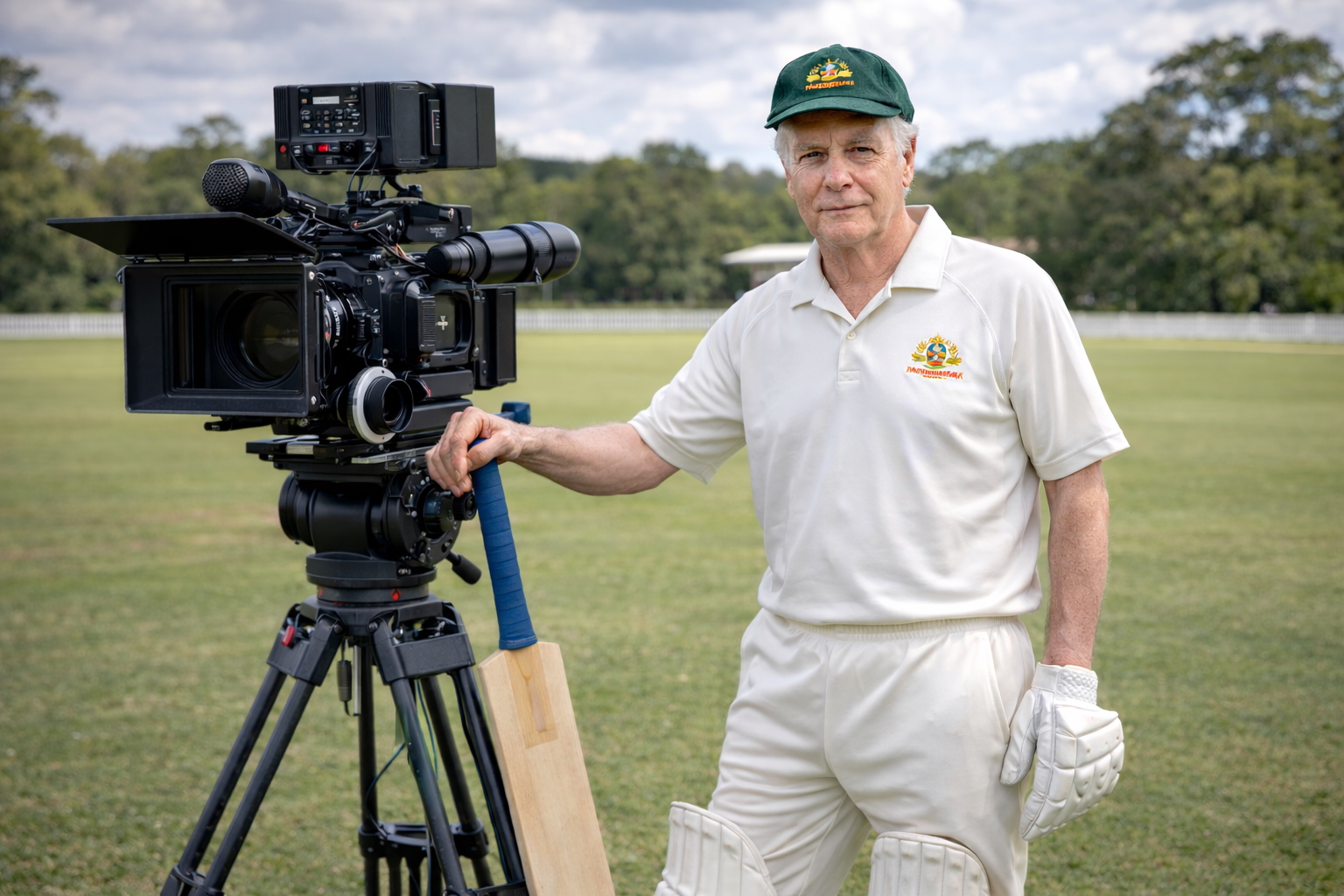
Thanks to ChatGPT for the image below.

Apologies Mr Anderson – you’ve made a great movie…

I went to one of the first 70mm screenings of Paul Thomas Anderson’s latest movie, One Battle After Another and walked out after the first 50 minutes.

I’m a huge fan of his work. I regard There will be Blood and Magnolia as great movies. Masterpieces? I’m not sure about that, but truly great movies nonetheless.

I had such high expectations for One Battle After Another and I was massively disappointed. I found it to be facile and devoid of anything original to say. Sean Penn’s performance annoyed me the most. Cheap facial expressions looking for characterisation.

Needless to say I ran against common thinking. Everyone lauded the film.. And I got canned for not watching the whole film.

Fair enough.
So I vowed to watch it again, all the way through.

I’ve been really busy lately and didn’t get the chance until last week, on a long flight from Sydney to Spain. I downloaded the film on my iPad Pro and watched it on the flight. With my Apple iPod Max over-ear noise-cancelling headphones. Not the best way to watch a film that had originally been shot in VistaVision, but I’d already seen it (or at least the first 50 mins) in 70mm so I got what it looked like.

But seeing it again, it was as though I was watching a different film.
I found it to be masterful, engaging from the first frame, and funny as hell.
And it had plenty to say, politically.
Important for our times.

In short, I loved the film.
And from this time on will shout its greatness from the rooftops.

So what happened?
Why did I have such a completely different reaction watching it on an iPad on a flight?

All I can put it down to was that I wasn’t in the right headspace when I first saw it in the cinema. I was distracted by work stuff that had been niggling me prior. I felt I should be somewhere else. And I wasn’t in the right frame of mind to accept the unorthodox approach that Mr Anderson was taking – an approach that annoyed the bejesus out of me at the time but which on a second viewing I found to be thrilling in its cinematic courage.

Later, I began to think of famous film critics that had historically trashed great movies.

  • Paulene Kael, Chief Film Critic for The New Yorker and perhaps the most influential film critic of her time, scorched Ridley Scott’s Blade Runner, writing that the movie “had nothing to say,” and that its storytelling was “inert.”
  • Variety dismissed Stanley Kubrick’s The Shining, as “a crashing disappointment,” and that it had “virtually no thrills.”
  • Kubrick’s science fiction masterpiece, 2001 A Space Odyssey, got a similar hiding from critics that said it was “boring, pretentious and incoherent.”
  • Alfred Hitchcock’s Vertigo, now second on the British Film Institute’s list of Greatest Films Ever Made was derided by critics, one of whom called it a “Hitchcock-and-bull story,” Psycho got even worse treatment, with critics calling it “gimmicky and tacky,” with one critic saying that it was “obviously a low budget job.”

Maybe these critics were like me when I sat down to watch One Battle After Another – they just weren’t in the right headspace.

You don’t need New Year’s Day Resolutions ~

In Australia it’s New Year’s Day.
A time when a lot of people make New Year’s Day resolutions.

You don’t need to!
Most New Year’s Day resolutions fall by the wayside within weeks.

I’ve discovered you can change your life any day of the year.
It doesn’t have to be the day that starts a new year –
It can be any day.

You just have to set the intention.

In November of last year, 2024, I set myself a November Challenge.
That’s what I called it.
My November challenge consisted of:

– a walk of 45mins or more each day, every day of the month.
– No added salt to my food.
– No processed sugar, in particular chocolate.

I would do this just for a month, that’s all – and after the month I could go back to my salty/chocolatey/lazy ways again, if I wished to.

Just a month.

I stuck to the challenge and got through November.

In December I found that I had no desire to go back to my salty/chocolatey/lazy ways, so I modified it a bit –
– 45 mins walk or indoor bike 6 days a week.
– processed sugar was okay if it was in a home made dish made with love.

The interesting thing is, with that November challenge I broke two entrenched habits and established a new one.

I broke the habit of pouring salt onto anything I ate, regardless of whether the food needed salt or not. And I haven’t had any chocolate since the start of the challenge. And I’ve kept the pledge to myself of doing a minimum of 45mins walk/indoor bike 6 days a week.

I think the trick to it was to set myself a finite goal – one month. And I told myself I could revert to my old ways after a month. But I discovered I didn’t want to. Then I modified my lifestyle choices according to the long term sustainability of it all.

Anyway, I just thought I’d put that out there.
You can change your life any day of the year!

Wishing you all everything good and wonderful and joyful this year –


Audit of 2024 and plans for 2025

As readers of this blog know, each year around this time I do an “audit” of what I achieved this year pegged against what I hoped to achieve this time last year. And I outline what I hope to achieve in the coming year.

This year was all about the release of The Way, My Way.

We released the film on 100+ screens across Australia and New Zealand on May 16th. The film opened out to about 330 screens and went on to become what many film analysts described as “the surprise hit of the year.”

We ended up playing in cinemas for 20 weeks – at a time when a film is lucky to last three weeks – and we did theatrical Box Office of close to $2.5m in Australia and New Zealand.

For Jennifer and me, this exceeded our expectations well and truly. I would have been cock-a-hoop with a 6 week run and a BO of $1m.

But the film was cleverly and adroitly handled by distributor Maslow Entertainment, headed up by Marc Wooldridge. Marc, along with his associate Alex Taylor, did a superlative job managing the film.

Marc quickly came to understand the Camino ethos and spirit, and it was that understanding that helped him power the film to the result that we got. Marc will be using his unique approach to help distribute the film across the US, commencing in March.

On a personal note, I very much enjoyed working with Marc this year. I quickly came to respect his knowledge and love of cinema, and his belief in the commercial viability of home-grown movies. Plus we laughed a lot. In this business, tough as it is, you’ve gotta have a laugh.

With the Australian release, Jennifer and I did our bit doing Q&A screenings around the country. It was exhausting, but we got to meet our audience on a personal level, which for us was enormously fulfilling. The Q&As also allowed us to witness first hand the impact the film had on many. Some people told us they’d seen the film five and six times.

We were joined for a few weeks on the Q&A tour by Camino legend and Elder Statesman Johnnie Walker – and that time spent with John was one of the highlights of the year for us.

As was later in the year when we screened the film for a large convention of European Camino leaders in Pula, Croatia. John organised the screening – he was there, with Jennifer and me, and we once again witnessed their overwhelmingly positive response to the film.

We got the same reaction, if not more so, when we screened the film later in the year as part of the St James Day celebrations in Santiago, Spain. Once again John set up the screening, held in a grand old theatre in the historic centre of the city. It was glorious, but scary. This was a cinema full of very experienced pilgrims. There could be no more critical audience. But fortunately they loved it.

John later hosted all of us – some of the cast that had attended the screening, and Executive Producer Rudi Wiesmeier and Sales Agent Simon Crowe – to an unforgettable lunch in John’s favourite restaurant in Santiago. John’s generosity and support for this film has been incredible.

In amongst all this I did other things.

Jennifer and I spent a good deal of the second half of the year working on a project to be shot in India, a story based on true events concerning what’s called a double honour killing. Unfortunately that film fell over – the Indian producer we were working with was not able to pull it all together within our timeframe.

So, how did I go with my laundry list of things I wanted to achieve this year? Here’s what I hoped to achieve this time last year, and in bold, what I actually did or did not achieve.

  • Release The Way, My Way theatrically in Australia and other territories world wide. Done, kind of. We did release the film theatrically in Australia and New Zealand, but not in other territories. That’s happening next year – 2025.
  • Release Facing Fear online globally. Done.
  • Publish a ten year anniversary edition of The Way, My Way. Done. I wrote an updated edition with an extra 15,000 words and it was published through Arcadia Press.
  • Publish a book of my Camino blog posts, called The Way, My Way – Posts from a Blog that became a Book that became a Film. Done – an 80,000 word manuscript that’s in the final stages of publication and will be available on Amazon by Christmas.
  • Complete the filming of Hope – the third in the series which includes PGS Intuition and Facing Fear. Not done. Couldn’t find the time.
  • Further development of my elephant film to be shot in India, tentatively titled Elephant Mountain. Done. The film is now called Mother Thunder. Development is continuing.
  • Write the screenplay to the sequel of The Way, My Way – titled The Way, Their Way. Done, although the film is now called “The Way, Her Way.” I’ve completed the script and Marc and his team at Maslow will be distributing once again.
  • Begin writing another novel – a metaphysical thriller. Done. Or rather, doing… The book is called “Dead Image,” and I’m 30,000 words into it.

On top of all this I commissioned Dan Mullins, of My Camino Podcast fame, to do the audiobook of The Way, My Way. That will be published on Audible.com by Christmas. And I’ve also begun active development on another movie, a crime-caper movie involving a group of dysfunctional pensioners. It’s a comedy.

As well, I spent time this year writing a non-fiction work detailing how I’ve changed since walking the Camino. The book is called If I can Change, You can Too. I’ve already this year written 15,000 words and will look at completing it this coming year.

So what do I hope to achieve in 2025?
This next year is going to be massive.
Here’s what I wish to do:

  • Release The Way, My Way in US and Canada – and support that release with a Q&A tour, from the beginning of February to the end of March.
  • Release The Way, My Way in Germany, Austria and Switzerland and support that release with a Q&A tour in April.
  • Screen The Way, My Way to an annual gathering of North American pilgrims in Vancouver in mid May.
  • Screen The Way, My Way to a convention of Camino leaders in Malta at the end of May.
  • Walk the Portuguese Camino (for the 3rd time!) in preparation for the shoot of The Way, Her Way.
  • Release The Way, My Way later in the year in Italy, and support that release.
  • Shoot The Way, Her Way on the Portuguese Camino in September / October.
  • Work on the post production of The Way, Her Way.
  • Write the first draft screenplay of the next movie in my Camino series – called The Way, His Way. (I aim to become the Taylor Sheridan of the Camino! haha)
  • Complete the writing of my metaphysical thriller, Dead Image.
  • Complete the writing of my non fiction book, If I can Change, You can Too.
  • Write a treatment of my dysfunctional pensioner crime-caper screenplay.
  • Shoot more material for the Hope film.

Seems like a lot?
It’s about how you use your time.
I try not to waste a moment.
I try…
But I am, by nature, a lazy man.

Mounting the production of The Way, Her Way in Portugal is once again going to be a big and complex undertaking, but that’s what Jennifer and I do. We’ve shot films on the remote Nullarbor Plains (Kiss or Kill), in Nova Scotia (Two if by Sea), in Papua New Guinea on the Trobriand Islands (In a Savage Land), in New Orleans (Tempted) on a remote Barrier Reef island (Uninhabited), and of course we shot The Way, My Way on the Camino in France and Spain. I seem to love setting my stories in exotic and logistically difficult locations!

On the health front, I end the year in my seventh year since diagnosis of my Parkinson’s disease. This year, with all the traveling and the tension involved in supporting the release of the film, and not being able to keep up my fitness regime, I saw a deterioration in my condition. That said, my neurologist, one of the country’s top Movement Disorders specialists, still rates me his gold-star patient – and hasn’t materially altered my medication for the past two years.

This coming year, I’ll be having cutting-edge stem-cell treatment in the US with one of the world’s leading experts in this field. He’s had spectacular results with Parkinson’s patients. Fingers crossed it slows the progression – it might even go some way to reversing the condition. We’ll see.

So that’s it – I achieved pretty much all of what I set out to achieve this year, plus some. And I’ve set an agenda for next year that would be challenging for someone half my age. But I don’t see age as a barrier. On the country, I feel more energised, and more capable, than at any time in my life.

Bring on 2025 is what I say!

The Golden Bridge – genesis

How my latest novel, The Golden Bridge, came into being is very strange – and I still don’t fully understand it.

It was in the middle of COVID, it was the middle of winter, and it was the middle of the night.

I woke up and there it was, right in front of me, fully formed.
I can’t explain it better than that.
The whole story was fully formed.
The character, the journey, the arc.
Everything I needed to start writing.

I hadn’t dreamt it.
This wasn’t the stuff of dreams.
But it woke me up.

I said no.

I didn’t want to write the story. I didn’t think there was a market for it. I didn’t want to spend 12 months of my life writing something that no one would ever get to read. It wasn’t the kind of story that I would normally write anyway. The whole thing just made no sense to me.

And so I said no.
I’m not going to write this.

They came back immediately and they said: Yes, you are going to write this!

Who were “they?”
I don’t know.
They were those that had delivered me the story, and they were insistent that I write this.

Again I said no.

I knew that to do the story justice, it would require a level of writing expertise that I didn’t think I possessed. I knew intuitively that it would be the hardest thing I would ever write.

I flat out said NO, this is not something I can do.
This is not something I want to do.
It will be a total waste of time.

(Here I am, in my bed in the middle of night, in the middle of winter, during the middle of the pandemic having this weird conversation in my mind with God knows what, or who. The whole thing was completely bizarre.)

They held firm.
They were not going to budge.
They told me I had to write it, and that was that.
No arguments.

So, a few days later I started.

I would get up at 4am or thereabouts, go downstairs and have a double espresso, and then in a half somnolent state I would begin to write. My job was to keep my mind clear so that I could allow an unfettered passage to whatever wished to come in.

I didn’t want to impose, I didn’t want to interfere.
I wrote with craft, of course, and with style.
To deny ego in a creative process is to deny your own unique voice.

I didn’t meditate.
I just tried to keep my mind clear.

I started out thinking it would be the hardest thing I would ever write.
It turned out to be the easiest.
And in fact now I look back at the manuscript and wonder how on earth did that happen?

I would write from about 4am-4:30am till about 9:30am. By that stage I would have written about 1,000 words, sometimes a little more. I didn’t take a day off until I’d finished. The book is approximately 75,000 words.

At times I would need to do research. The chapter The Dowser required research. I found myself reading a lot of Alice Bailey’s work, in particular The Soul and its Mechanism, and The Consciousness of the Atom. Also Saint Germain on Alchemy.

But most of the book just came to me.

When I finished the manuscript I did some revisions, and then I sought publication. I got an offer from a major New York publishing house and suddenly found myself with a publisher that had published the works of some incredibly famous people. Like, seriously famous authors.

But the fit wasn’t right.

I wasn’t happy with the commercial deal terms, and I wasn’t convinced that the publisher would really work my book. I worried that it could just get lost in amongst everything else he was doing. So I pulled away.

The book is now set up with a smaller imprint based in Melbourne. I know this publisher, James Terry at Arcadia Press, and I know James will work the book hard to get it into the best bookstores and outlets. The book will be formally launched by Arcadia early next year.

In the interim I have put the book out on Amazon –

The Golden Bridge on Amazon.com
The Golden Bridge on Amazon.com.au

Some people who’ve read it describe it as “the new The Alchemist.”
Someone else described it as “a quiet little masterpiece.”

All I know is that this book came to me in a seriously weird way. Was it channelled? All creative endeavours are channelled. That’s how creativity works. Having a work channelled doesn’t make it special. That’s the norm.

But if I leave this plane having written The Golden Bridge and made the film The Way, My Way, then I’ll be happy that my work here is done. Anything else is a bonus.

Why elephants? Why India?

We’ve shifted into sound post production with The Way, My Way – and there’s not much for us to do at this stage of things, so I decided that Jennifer and I could productively use our time to do research and location surveys on a story that’s intrigued me for some time.

And by some time, I mean for about twelve years or so.
That’s often how long I need to sit with a story to allow it to marinate before I feel sufficiently comfortable to move ahead on it – or not.

Kiss or Kill took ten years, In a Savage Land took eight, The Nugget had a long gestation period of over a decade, and this current film The Way, My Way, was percolating away for seven years before we upped tools and began production.

I can’t really remember when I first read Tarquin Hall’s To an Elephant Graveyard, but it would have been a good twelve years ago, maybe longer.

It was an obscure book, set in Assam in the north east of India, and it detailed how a council of villagers hired a hunter to track down and kill a “rogue” elephant. The story was told through the eyes of a journalist sympathetic to the elephant.

I found it a fascinating story, and one that would allow me to explore the destruction of natural habitats, and the dysfunction and disconnect between man and nature.

Assam though is fraught with political difficulties, not a very safe place to visit I was told, but then in research I discovered that there was a place called the Elephant Mountains in a remote region of Tamil Nadu in southern India that had one of the largest concentration of elephants in the world.

I also discovered that a scientist by the name of Dr Anand Kumar, Chief Scientist at the Nature Conservation Foundation, was a world expert in what’s called elephant / human conflict. In other words, deaths resulting from human / elephant interactions. The place where he’d done most of his research was in the Elephant Mountains.

So I contacted Dr Kumar from Australia and arranged for Jennifer and me to spend a few days with him and his associate in the NCF, Ganesh Raghunathan. (Ganesha by the way is one of the most prominent of Hindi gods – an elephant god believed to be a clearer of obstacles.)

They were very generous with their time with us. And they immediately informed me that the story in To an Elephant Graveyard simply wouldn’t fly.

For starters they railed against the notion of a rogue or killer elephant. In scientific terms they didn’t see elephants in that way at all. Elephant behaviour was far more complex and sophisticated – and to be branded rogue or killer was simply sensationalism – and they wished to have no part in any production that sought to go down that path.

Equally, they said that a village group hiring a hunter to kill an elephant just wouldn’t happen, even fifteen or twenty years ago. Apart from the fact that it was then and still is illegal, they pointed out that elephants in India are deities — they worship Ganesha, the elephant god.

So that killed stone dead my thoughts of making a film around that book.
That’s okay.
Maybe there was a better story to be told within this arena.

And there is!
A way better story.

During the time spent with Anand and Ganesh, they gave us information and told us true stories which you simply couldn’t make up.

Put into a dramatic narrative form, they will make for a film that will have way more impact than the story I started out with. It will be far more intriguing, and it will say things about the co-existance of man and the natural world in ways that will be fresh, original, and will be a full-blast emotional rollercoaster.

Jennifer and I had to come to the Elephant Mountains and spend time with these very special people and get out and see locations for ourselves – be on the ground talking not only to scientists but villagers and others as well – to feel comfortable that we will be attempting to undertake a film that, like The Way, My Way, can be told with the utmost authenticity.

Now I have a big write ahead of me.