Steve McCurry, you are a master…
Light of Faith
Steve McCurry, you are a master…
I have just posted this on the forum – I’ll discuss it with you over there…
Please join up and join me…
http://www.pgsthewayforum.com/forum
A foolish man and a pretty young girl…
I met this beautiful young girl on my walk –
She was Italian, and she was dressed all in white. Flowing diaphanous white scarfs and robes. She had dark skin and dark hair and flashing eyes. When she smiled, you reached for your shades. It was dazzling. She was dazzling.
Thing about this girl – she wasn’t wearing a backpack. She didn’t even have a daypack.
I got talking to her, as you do, and she told me she was having a problem with one of her legs. It was sore. And a man had come along and offered to carry her backpack for her. He had his own backpack, but he carried hers as well for about 10kms along a tough and difficult section of the track.
I thought this was a very chivalrous thing for this man to do. Later I met up with him. He was mid 40s I guessed, and had gone ahead of her and was sitting by the side of the road, the two backpacks on the ground beside him. Both were large, and both looked heavy.
He looked exhausted from carrying the two packs. He asked me if I’d seen the girl. I had seen her. She’d gone ahead of me, her leg apparently not that sore, then met up with a very handsome young Canadian boy. The last I saw of them, they were canoodling in a field by a creek.
I didn’t wish to tell this man what I’d seen. I got the feeling his offering to carry her backpack had not only been an act of chivalry, but also an expression of romantic intent. Certainly the girl was in no hurry to leave her Canadian beau and reclaim her backpack.
I walked on, wondering how long he would wait for her. Or whether he’d carry those two backpacks back along the trail, and discover the Italian white vision in a clutch with her new Camino buddy… if so, how would the man react?
Was he an old fool? Had the girl artfully manipulated him?
I’ll never know – one of the great mysteries of the Camino.
What do you think?
Bill
Some of you have asked what I would do if I found €1,000 on the Camino.
To recap, here are the circumstances: It’s a bundle of cash – found by the side of the trail, as if it had fallen out of a pocket. Or perhaps at a wayside rest stop – on the ground beside a table and bench, maybe. €1,000 in cash. It’s nearly lunch, and I’m just outside a town or village –
Okay, so that’s the scenario. What would I do?
Firstly I’d photograph the cash, in situ. I’d photograph where it was on the ground, in relation to other features around – such as, was it beside or underneath a picnic table, or by a creek or near a bridge? In other words, I’d photograph it forensically, like a crime scene.
Most importantly, I’d determine if the cash was in clear line of sight of anyone walking along that trail. In other words, was I likely to have been the first person to find that cash? Or was it hidden from view?
If it was hidden, then it could have been lying there for days, maybe weeks. If it was clearly visible to any pilgrim walking along that trail, then that would tell me it had probably been dropped only recently – and perhaps the person who dropped it was not far up ahead of me.
Then I’d examine the cash. Was it folded in half? Or rolled up? Was the wad held together with a rubber band, or any kind of note pin? And what denomination were the bills? €100? Or all €50 bills, or a combination of smaller notes?
And then I’d carefully count it. Was it €1,000 exactly? Or €1,200? Or €980? Was it 9 x €100, plus 1 x €50 and 2 x €20. If so, then that would tell me if someone had cashed one of the €100 bills and bought something for €10. It would also tell me that the money had been withdrawn recently, because most likely that was the only breakage of the €1,000 stash.
I would then quickly set off to try and catch up to the pilgrims up ahead of me. I would sidle up to them, and casually ask if they’d lost anything. I wouldn’t mention cash…
Anyone carrying that amount of money would have an immediate and undisguised reaction if they suddenly discovered they’d lost their cash. Straight away I’d be able to read the truthfulness of that response.
And if there were no pilgrims ahead of me, then I’d walk into the town and go from cafe to bar to restaurant, and again ask casually if anyone had lost anything. Again I’d be able to read a true or false response.
If someone did say they’d lost some cash, I’d ask how much. Most of us don’t know exactly how much money we’re carrying at any point in time, but if someone said they’d lost €50, then I’d know they weren’t the right person. If someone said they’d lost €1,000, and in fact it was €980, then I’d ask further questions.
If I’d found the money at a rest spot – at a picnic table for instance, I’d ask if they’d stopped anywhere that morning, and if so where… in other words, I’d try and determine the truth of the claim.
However, if I didn’t find anyone who had a credible claim to the cash, I’d then go to the police. I’d tell them I’d found some money, and I’d give them my email and mobile phone number and ask that if a person came forward to report the missing cash, then they were to contact me.
I wouldn’t leave the money with the police.
I would then do the same thing with the albergues in town, and I’d probably walk on further that afternoon, and do the same thing in the next town.
I would hold onto the money, and put it away in a safe place, and wait for someone to contact me. If I had not been contacted by the time I got to Santiago, or after several weeks if I’d found the money early in my walk, then I would give the money away.
I wouldn’t give it to a church, or a monastery.
I would arbitrarily choose someone at random, someone my PGS told me needed the money – someone in the street, or in a church, or sitting at a bus stop. I would walk up to them, simply give them the cash, and walk away.
What if you found €1,000 while you were walking the Camino…
What would you do?
Let’s say you found it – a bundle of cash – by the side of the trail. As if someone had pulled something out of their pocket, and the money had fallen out. Or at a wayside stop – on the ground beside a table and bench. €1,000 in cash.
What would you do?
Let’s say it’s nearly lunch, you’re just outside a town or village –
If you did keep the wad of cash, would you feel elated? Or guilty? Would you consider that the Camino had slyly tested you, challenged your moral core, and you’d failed?
In other words, how would you feel?
And if you did keep the cash, what would you do with it? Would you put it away some place safe, in case you found the person who’d lost it?
Or would you immediately spend it? And if so, what would you spend it on? A slap-up dinner, to celebrate? And while celebrating, would you ever consider that your fortune was someone else’s misfortune?
I am staggered at how many people have done, are doing, or will do the Camino because of the movie, The Way.
From a craft perspective, it's not a great film.
From a box office perspective, it was a complete flop. It's opening weekend in the US was $110,000. That's embarrassing.
It's total world wide box office to date is $4.4m. That's a dud. That kind of box office ends careers.
Yet it's Rotten Tomatoes score – an industry guide now to how a film is received by critics and audiences – is spectacular.
82% of critics liked it, and 83% of audiences liked it.
Those kind of numbers save careers. And interestingly, the critics and audience numbers are almost identical. That's rare.
But culturally, the film has had a huge impact.
Huge.
I cannot count how many people I've spoken to who have told me that they decided to walk the Camino after seeing that film. And not only Americans – but people from all over the world.
Cinema can have a powerfully beneficial impact on society, as this film has had, and continues to have.
But I'm curious to hear from you guys – what was it about The Way, after seeing it, that made you want to walk the Camino?
It’s nearly 3 months now since I finished my Camino, and I feel confident I can now list some permanent changes as a result of the walk.
I will restrict this list to those “outward” changes that are most obvious, not the inner recalibrations and reshufflings that have occurred as a result of the walk, and are more significant than this following list.
But this list of “little things” indicates greater and deeper change underneath.
Who’d have thought that a “simple” walk could initiate such change – and I haven’t even begun to talk about the deeper stuff…
The Camino made me laugh.
There was a stage, during my walk, when it occurred to me that during the past couple of weeks, I hadn't laughed so much in years – since I was in my youth, probably.
And I realised that my face had changed. Physically. It was like the Camino had cracked a mask that had been formed by decades of life's vicissitudes.
Struggle, disappointment, conflict, resistance, anger, determination – all these things had etched their way into my face.
The Camino changed that.
I found myself laughing spontaneously – often over the littlest things. I found myself smiling while I was walking. I found myself greeting strangers with genuine warmth.
I discovered I was happy.
That to me is one of the Camino's most powerful restorative tools. The ability to make you laugh. To make you happy.
Please post here below any incident or situation that happened on the Camino, or in your preparation, that made you laugh…
Perhaps it’s an appropriate time to discuss loss.
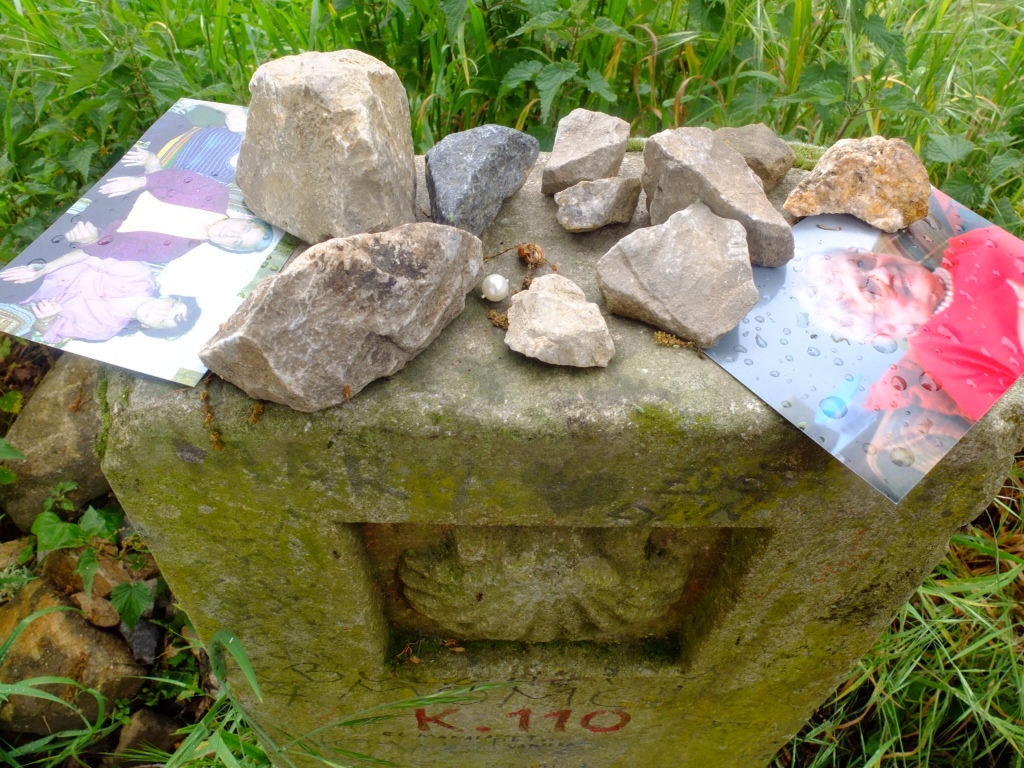
Amongst the most affecting images I took on my Camino – images that really hit me hard – were the shots I took of the photographs of loved ones left on markers, tucked into wire fences, placed inside roadside shrines, and of course attached to the Cruz de Ferro.
I was reminded that for so many people, the Camino is a pilgrimage walk of bereavement. A time of infinite sadness, seeking solace for the loss of someone dearly loved, sorely missed.
Sometimes these photographs were simply placed on the top of a stone mileage marker, weighed down by a rock, and whenever I saw them I would stop, and look at the face in the photo.
I would wonder who that person was, how had he or she died? And who put the photo there? Was it a son or daughter? Was it a father or mother, or friend or lover?
Sometimes I saw a pilgrim stop by a cross or memorial by the side of the track, and they would pray. I wondered if they too were carrying the heavy loss of a loved one with them.
The Camino is there for each of us, not just for achievement or personal growth, but for solace, and for healing, and for forgiveness.
What should have been a day of feasting and celebrations today in Santiago will have been a day of mourning.
I still can’t believe the timing, on the eve of St. James Day, and the location – on the fringe of the pilgrimage city.
For pilgrims arriving in Santiago today, having finished their Camino, it must be a strange place they’ve walked into. A grieving city.
I always think of Santiago as being a place full of light. And laughter. I can’t imagine there’s much light there today. Nor much laughter.
But it will return.
You must be logged in to post a comment.